The announcement of a General Election on 4 July makes it an appropriate time to look back at how the connection between politics and regulation may have been a factor in Ofcom’s attitude to GB News at the time of the channel’s launch in June 2021.
The relevant sequence of events began in 2018:
2018 Lord Burns was appointed as Chair of Ofcom for a 4 year term. The appointment was made while Theresa May was Prime Minister.
June 2019 It was announced that the CEO of Ofcom, Sharon White, would be stepping down to become the Chair of the John Lewis Partnership. Lord Burns soon began the search for a replacement for his CEO.
July 2019 Boris Johnson became Prime Minister and focused, among other things, on getting the ‘right people’ into important public appointments.
2020 Lord Burns resigned as Chair after only 2 years and Melanie Dawes was appointed CEO. This was an unusual combination of events, normally Ofcom chairs like to be around to settle in a new CEO. It led to speculation that Melanie Dawes was Terry Burns’s preferred candidate for CEO but that Boris Johnson had insisted that Burns departure was the price of her appointment. The Guardian reported; ‘Burns is believed to have tussled with the prime minister over the appointment of a new Ofcom chief executive. Eventually he agreed to leave in order to get his own choice of Melanie Dawes’. The deputy Chair Maggie Carver became the acting Chair while the Government set about installing Paul Dacre, former Editor of the Daily Mail, as the new Chair..
May 2021 Paul Dacre’s application for the post of Chair appeared to fall at the first fence when a panel considering it rejected him. However Boris Johnson’s Government refused to accept this as the final word and set about re-running the selection process in a different way to ensure Dacre’s appointment.
June 2021 GB News launched and after only one week Ofcom executive Kevin Bakhurst told a Media Society event that he saw nothing wrong with the content. This was another unusual event. Normally Ofcom executives would not give an instant judgement on a new channel especially when it was clear there were going to be complaints which Ofcom would have to consider.
Nov 2021 Paul Dacre pulled out of the contest to become Chair and questioned whether Melanie Dawes was up to the job. The Guardian reported: ‘Dacre said the prime minister had given him the go-ahead to sack the existing Ofcom chief executive, Melanie Dawes, and appoint a fresh figure’ .
The bottom line: at the very moment GB News was launching and Ofcom was considering whether it breached the due impartiality rules the regulator’s CEO was aware that the Government was determined to install Paul Dacre as her new boss.
If these circumstances led Ofcom to make a decision about GB News’s compliance or otherwise with the due impartiality regulations because of the likely views of the man they expected the Government to appoint as their new Chair that would be unprecedented and it would be wrong.
Everyday I get newsletters from the USA about developments in the media and most are very introspective and focused on industry insider gossip. But occasionally I read something that seems to have real reasonance for news media outside America. This article is from the Reliable Sources email sent out by CNN each weekday. It’s free and you can subscribe via this CNN portal .
The author, Oliver Darcy, argues that the new kids on the media block eg Netflix avoid news content for two reasons. One is that entertainment is more popular. ‘Second, and perhaps more importantly for these companies, news has become incredibly polarizing in recent years’.
I would argue that the growth of partisan news channels is not benefiting broadcast journalism but giving media businesses further reasons to avoid it. Here is the CNN article.
‘Netflix is rebuilding the cable bundle, sans one important ingredient: news.
The company, having blown up the decades-old linear television business and ushered in the costly and destabilizing era of streaming, is inching closer and closer to resembling the entertainment behemoths of yesteryear.
Netflix has added advertisements to its plans, a move it initially resisted for several years, touting more than 40 million subscribers to the ad-supported tier on Wednesday. It has added live late-night comedy, most recently with the roast of Tom Brady and John Mulaney’s “Everybody’s In L.A.” And it has made great strides into the live-sports arena, despite public statements asserting it does not wish to wade far into such waters.
On Wednesday, the streaming giant announced that it had struck a groundbreaking deal with the NFL to broadcast not one, but two games on Christmas Day this year. Those games add to the company’s ever growing portfolio of live-sports offerings, including WWE “Raw,” which will air exclusively on the platform starting next year.
“Last year, we decided to take a big bet on live — tapping into massive fandoms across comedy, reality TV, sports and more,” Bela Bajaria, Netflix chief content officer, said in a statement explaining the decision.
Notably absent from Bajaria’s statement and the company’s programming strategy, however, is news. Netflix has shown little-to-no interest in investing in either live-news or pre-taped programming (a la, a show akin to “Vice News Tonight” or “60 Minutes”). To date, it has neither publicly discussed nor launched any such projects. And in conversations with talent agents, it has made clear that the streamer has no interest in even dabbling in the news business.
“The entertainment platforms are not interested in news,” one talent agent, speaking on the condition of anonymity, told me. “Their audiences don’t want it and it can be polarizing. It’s just not worth it for them.”
In actively avoiding the news, Netflix joins Meta as a pioneering technology and media company that has upended the business models news organizations have relied on for decades, only to turn its back on the industry.
To be fair to these companies, there are plenty of business reasons to avoid dabbling in the news. First, news reporting is simply not as popular as entertainment content. Second, and perhaps more importantly for these companies, news has become incredibly polarizing in recent years.
Simply stating that the 2020 presidential election was not stolen — a proven fact — alienates Republicans. That polarizing factor means that not only is it more difficult to sell advertisements around the content, but that by carrying such programming, there is a chance a swath of the customer base will be turned off by the brand and motivated to unsubscribe.
Which is all to say that Netflix investing in news programming would translate into spending money on content that is not as popular as other genres, but far more risky to the overall business. From a purely business standpoint, avoiding that type of programming make sense.
Of course, the counterargument is that these companies perhaps have a civic responsibility to invest in news and public affairs programming — especially since they contributed greatly to the destruction of the business model that had supported television newsrooms for so long. Journalists are crucial to thriving democracies and the hollowing out of the news industry has vast implications for the future of the free world.
It’s anything but unprecedented for large media companies to invest money in journalism. Warner Bros. Discovery has CNN. Comcast has NBC News.Disney has ABC News. Paramount has CBS News. The list goes on. And, back when cable was ascendant and disruptive, as Netflix is today, the major carriers financed the birth of C-SPAN,offering the public a continuous feed of its government at work. So is it really out of the question to wonder whether a streamer like Netflix should consider a similar move to offer news programming that informs and enriches the public?
Rebuilding the traditional cable package without news is akin to putting together a meal that includes steak, potatoes, and ice cream, but not the broccoli. The vegetables might not be the tastiest, most popular item on the menu, but neglecting them would not be healthy. Likewise, only investing in comedy and sports might be more satisfying for its audience, but it certainly isn’t a healthy choice for society.
That is the destination, though, where the current decisions are leading. And as the streaming revolution continues to take the wind out of the traditional cable bundle by poaching the rights to live sports, the once-towering television news outlets will be further diminished, turning the situation even more dire. ‘
This is a summary written by my former Ofcom colleague Chris Banatvala of the written evidence which we provided to the House of Lords Communications and Digital Committee’s inquiry into ‘The future of News’. Our full evidence is at https://committees.parliament.uk/writtenevidence/130308/html
Stewart Purvis and Chris Banatvala’s concerns focus on two areas:
1) The manner in which Ofcom is now regulating due impartiality.
2) The use of ‘politicians’ to present current affairs programmes (especially at election time) and Ofcom’s use of its recent research into the area.
1) The manner in which Ofcom is now regulating due impartiality.
• Ofcom is not investigating cases which warrant investigation.
• Ofcom is not publishing some ‘not-upheld’ decisions where there is a public interest in doing so.
• News and controversial matters (which appear in current affairs programmes) must both, according to the law, be treated with due impartiality.
• There is no lower test e.g. for current affairs programmes. So why can politicians present current affairs programmes(interviewing colleagues from the same party)?
• There is no basis for treating smaller channels differently from e.g. PSBs.
2) The use of active politicians to present current affairs programmes and Ofcom’s research.
Ofcom recently published research (157 participants) on public attitudes to politicians presenting current affairs (they are not allowed to present news).
• While the research was underway, Ofcom Chair, Lord Grade in a Q&A session stated “I don’t think it’s very difficult what is a news programme and a current affairs programme, I don’t think that’s difficult at all, we all know the difference between Panorama and News at Ten”. When challenged that new genres make it confusing, he responded “It’s not confusing, not confusing at all.”
• However, the Ofcom research proved the exact opposite.
• IPSOS said that viewers “struggled to consistently [tell the difference] in practice”.
• The conclusion from the research firm was “Although there was concern about politicians presenting current affairs content, there was no consensus for preventing them from doing so”.
• Ofcom uses the research to claim that viewers do not want to ban politicians as presenters of current affairs programmes.
• However, given that the public cannot tell the difference between news and current affairs programmes and the “most prevalent opinion…was feeling unconformable with politicians presenting”, the research raises more issues than it resolves.
Recommendations:
• Ofcom should launch a public consultation on the use of politicians in programmes (especially current affairs).
• Parliament should ensure that Ofcom fulfils its statutory duty with respect to due impartiality on all channels.
• Parliament should consider amending the legislation to make it clear that the same level of due impartiality applies to current affairs programmes (dealing with controversial matters) as news.
Ofcom have published more than 100 pages of research and new guidance about their rules on ‘due impartiality’ which will probably affect GB News the most. Are we any wiser about the impact on the forthcoming general election campaign?
1. What’s the bottom line?
Last month I wrote an article for the Guardian with a former colleague at Ofcom, Chris Banatvala. We asked three questions, now we have enough information from Ofcom on their current policies to be able to answer our own questions.
Q Is Ofcom going to allow senior party officials to present election programmes as long as they are not actual candidates?
A Yes. Under Ofcom’s current interpretation of their rules the Honorary President of the Reform UK Party, Nigel Farage, who is also a director and co-owner of the party, will be able to present his weeknight prime time programme on GB News unless he stands as a candidate. He will be able to do this throughout the election campaign – even though Reform UK says it will stand around 600 candidates
Q Could a channel host party loyalists from only one side, delivering nightly unchallenged polemics on each day’s campaign news?
A. Yes unless they are candidates. And party officials, assembly members and political activists will all be allowed to interview representatives of their own party every day of the campaign. Ofcom would probably challenge the word ‘unchallenged’ but the truth is that day after day on GB News contentious statements are made and not challenged and there is little regulatory follow-up.
Q. Will channels with poor compliance records and fewer viewers than the public service broadcasters be given greater flexibility in achieving “due impartiality” on the basis of what Ofcom calls “audience expectations”?
A.The suggestion that Ofcom was operating this two-tier system came from none other than the CEO of Ofcom, Dame Melanie Dawes, when she told an event in Oxford ‘the standard for someone like the BBC, which reaches still 70 per cent of the TV viewing audience, [for] the news is a different one from that of a channel that has an audience of maybe four or five per cent of the viewing public. We expect different things. And I think that’s appropriate.”
When challenged before a potential legal action by Professor Julian Petley and the Good Law Practice, Ofcom now say that these were ‘two brief remarks made in the context of a live Q&A interview’ and that the comments ‘were clearly not intended to be, and should not be taken as, an unpublished policy position of Ofcom’. I think that’s Ofcom code for ‘the CEO mis-spoke’.
2. What does the audience research show ?
Ofcom say ‘the report captures a wide range of views but, overall, the audience feedback supports the broad design of existing due impartiality rules under the Broadcasting Code’. Cynics would suggest that’s exactly what the research was designed to do so let’s examine one issue in detail.
Under Ofcom’s current interpretation of the rules politicians cannot present news programmes but they can present ‘current affairs’. As I have pointed out before the distinction between these two genres was not set out in the law that created Ofcom, the regulations Ofcom enforce or the guidance it has provided to broadcasters. It only existed in a blog by an executive. Now Ofcom is taking the opportunity provided by the research to change the guidance to codify the blog. But is that what the audience research really shows?
When the research project was first commissioned the Ofcom Chairman, Lord Grade, took the unusual step of predicting what it would discover, telling a Voice of the Listener and Viewer conference that he was sure the audience would know the difference between news and current affairs.
The evidence from ’29 focus groups with 157 participants from range of backgrounds, reflecting different political leanings and media consumption habits from all across the UK’ tells a different story. This being ‘qualitative’ not ‘quantitative’ the research company Ipsos does not provide numbers of who thinks what but instead attempts to summarise what the groups said.
‘Participants thought they could easily distinguish between news and current affairs content and name common features of both in principle. However, in practice, the presentation and style of these types of content blurred the line between news and current affairs which confused participants particularly when a programme contained both’.
Dig deeper and you find the audience was even more confused. Four of the key characteristics they associated with news programmes but not current affairs : ’studio backdrop / presenter siting behind a desk / rolling banner /ticker’ are all prominent parts of Nigel Farage’s programme which he is only allowed to present because Ofcom deems it ‘current affairs’.
A further irony is that two of the characteristics they associate with news, rolling banners and tickers, don’t actually appear in news programmes such as the BBC’s Six O’Clock News and ITV’s News at Ten.
This was an especially disappointing result for Ofcom when you consider that the ‘stimulus materials’, the video clips shown to the focus groups, did not include any ‘hybrid’ programmes such as BBC Radio Four ‘Today’, Channel Four News, BBC Newsnight and rolling news sections of Sky News which all have elements of both genres. Such clips would have left the focus groups even more confused since most of the people who make them are not sure themselves if they are news or current affairs or both. Ofcom itself also seems confused. Under its definition these hybrid programmes are probably both news and current affairs. But it always seems to investigate them as news.
So if the evidence is that viewers think they know the difference but actually don’t, what do they think of the principle of politicians presenting ‘current affairs’ programmes?
Ipsos is absolutely clear;
‘The most prevalent opinion held among participants was feeling uncomfortable with politicians presenting current affairs content’.
The raw material includes quotes such as
‘I just don’t think politicians should be doing all these current affairs programmes, or not as many. Female, South England, 55+’.
‘It undermines the topic they’re presenting or discussing. To be on the safe side, stick with presenters who aren’t associated with politics in any way.” Female, Midlands, 35-54.’
But do the viewers think the rules should allow politicians to present these programmes?
Ipsos says ‘not everyone in this group thought they should be prevented from doing so’.
Should we be surprised by that when we read that 11 of the 29 groups ‘were conducted with audiences of channels where politicians have been presenting current affairs programmes more regularly’. You might well expect that ‘not everyone’ in these groups would like to stop the programmes they watch. The real question is was there an overall majority of people who thought that politicians shouldn’t present current affairs programmes. Ipsos would know this but we aren’t told.
Instead Ipsos concludes:
‘Across groups there was common concern about politicians presenting current affairs content, but this did not equate to a consensus on preventing them from presenting such content’.
Ofcom go one step further in their press release :
‘People expressed a range of views about politicians presenting current affairs programmes, but although there were concerns, there’s no clear consensus for an outright ban’.
So ‘a prevalent view’ among viewers that they are ‘feeling uncomfortable’ has been diluted to ‘a range of views’
The final twist comes when an Ofcom executive, Cristina Nicolotti Squires, a former ITN colleague, appears on Radio 4’s Media Show and announces :
‘When it came to current affairs they didn’t particularly like politicians presenting it but they didn’t want it banned’.
Now ‘not everybody’ agreed to a ban has been strengthened to ‘they didn’t want it banned’.
Some evidence base.
3.What subjects weren’t the focus groups asked about?
I can’t find any mention of any groups being asked what they thought of the fact that the politicians who present on GB News all come from the same side of the political divide.
Nor, it seems, were they asked what they would consider to be a reasonable proportion of a programme that should be given to views which are an alternative to those of the politicians who gave the opening monologue.
Perhaps Ofcom didn’t want to know the answer.
My colleague, Chris Banatvala adds this important final point : ‘when all is said and done, this qualitative research shows ‘Across groups there was common concern about politicians presenting current affairs content‘. Surely that is the beginning of the debate and not, as Ofcom seems to imply, the end’.
The five ‘guilty’ verdicts by Ofcom against GB News followed by the broadcaster’s angry response suggest there could be an escalating battle between the two sides over the issue of whether politicians, especially MPs, can present political programmes. I doubt it but there could be a bigger, wider and even more important battle ahead.
The creation of GB News has crystallised two separate but sometimes connected issues:
What programmes are serving politicians, especially current MPs, allowed to present on TV ?
When presenters, be they politicians or anybody else, express strong opinions on topical matters how is due impartiality achieved?
Issue 1:What programmes are serving politicians, especially current MPs, allowed to present on TV?
Nothing in the current law, Ofcom Code or Guidance sets out what a serving politician can present, only what they can’t:
‘Rule 5.3: No politician may be used as a newsreader, interviewer or reporter in any news programmes unless, exceptionally, it is editorially justified. In that case, the political allegiance of that person must be made clear to the audience’.
So what is a news programme that a politician can’t present?
The Code itself doesn’t define a news programme but the guidance has this significant section:
‘1.8 In terms of this section of the Code (i.e. the requirement for ‘due impartiality’ and ‘due accuracy’), news in whatever form would include news bulletins, news flashes and daily news magazine programmes’.
One thing is clear : the authors of the guidance intended that the definition of a news programme should cover more than just a news bulletin. ‘News in whatever form’ seems pretty clear. But soon after GB News started inviting politicians from the right – but not the centre or the left – to present daily programmes about the political news of the day Kevin Bakhurst, then the senior Ofcom executive in charge of content regulation, published a blog justifying the practice.
He produced a definition of a news programme which restricted it to a news bulletin. By doing so he argued that the politicians on GB News were not presenting ‘news programmes’ but what he called ‘current affairs’. The term ‘current affairs’ does not appear anywhere in the impartiality sections of the Communications Act, the Ofcom Code on Impartiality or the Ofcom guidance. This was, in effect, Kevin’s Law, there was never a consultation or debate about it. Ofcom now relies upon what was in his blog (he has since left Ofcom) to support its judgements.
The recent Ofcom judgements against GB News show the confusion this has created. When Jacob Rees-Mogg delivers his Moggolgue on that day’s political news, much of which goes unchallenged in the programme, he is apparently a ‘current affairs’ presenter but the moment he mentions breaking news he has been transformed into a ‘news presenter’ which, of course, he’s not allowed to be. Hope you are still with me. The obvious solution is not too difficult, every time news breaks inside these programmes the presenter should hand over to the newsroom presenter. That’s if GB News wants a solution rather than escalate the issue for its own reasons.
But none of this solves the bigger problem as we approach the local and General Elections, should politicians be allowed to present programmes about that day’s political news whether or not you call them News or Current affairs.
The simple and best solution: politicians should not be allowed to present programmes which report and debate the controversial issues of the day especially political news unless there are exceptional circumstances. That’s what we thought the rules said so why not return to that.
Which takes us onto …
Issue 2; When presenters, be they politicians or anybody else, express strong opinions on topical matters how is due impartiality achieved?
This issue has been overlooked during the row about politician presenters but in fact it is equally important .
What the Code currently says:
‘5.9: Presenters and reporters (with the exception of news presenters and reporters in news programmes), presenters of “personal view” or “authored” programmes or items, and chairs of discussion programmes may express their own views on matters of political or industrial controversy or matters relating to current public policy. However, alternative viewpoints must be adequately represented either in the programme, or in a series of programmes taken as a whole. Additionally, presenters must not use the advantage of regular appearances to promote their views in a way that compromises the requirement for due impartiality. Presenter phone-ins must encourage and must not exclude alternative views’.
A number of points arise from this:
The implication of the first part of the first sentence is that news presenters and reporters in news programmes may not express their own views on current controversies or current public policy.
However presenters of non-news programmes can do so subject to the condition that alternative viewpoints must be adequately represented in the programme or a series of programmes. This is explained in the guidance:
‘1.48 Broadcasters are free to include ‘issue-led’ presenters in their programming, as long as they maintain due impartiality as appropriate. In clearly signalled ‘personal view’ programmes, many in the audience are comfortable with adjusting their expectations of due impartiality. However, in order to maintain due impartiality, alternative viewpoints should be adequately represented’.
How adequate does the representation of alternative viewpoints have to be? The Code and Guidance are not prescriptive about this. According to a Guardian article :
‘The broadcast code enforced by Ofcom is clear that opinionated hosts are fine but “alternative viewpoints must be adequately represented”. It has not specified what exactly that means, but GB News insiders believe 10-15% representation for differing views is probably adequate’.
Ofcom refuses to put a figure on ‘adequate’ but I believe the figure of 10-15% is an accurate statement of the view inside Ofcom and GB News. Is that a satisfactory figure for Ofcom when the 85-90% of political views expressed on GB News come from the same perspective in every primetime programme every night?
The implications for the General Election campaign are serious. Ofcom has still not grappled with this issue of whether leading supporters of the same side (only actual candidates are disqualified during election campaigns) can appear night after night giving an unchallenged monologue on that day’s news. On Ofcom’s current interpretation of its code it seems this can continue during an election campaign. Surely that has to change. Can we really have election campaign coverage presented by Boris Johnson and Nigel Farage where they and like-minded folk are free to say what they like about other parties but Labour and Lib Dem supporters get only 10-15% of the programme airtime between them to respond?
Nigel Farage, not normally a man for self-doubt, has admitted it ‘could be tricky’ choosing between party politics and broadcasting during a General Election campaign. Interviewed for Politico’s ‘Westminster Insider’ podcast ‘Inside GB News’ about his future as the Honorary President of the Reform UK Party he replied:
‘if I want to cover a General Election for GB News under a period of purdah, it could be tricky couldn’t it, could be very difficult and I think ..but I don’t know, I’m thinking very hard about it. But I think it is an either/or choice’
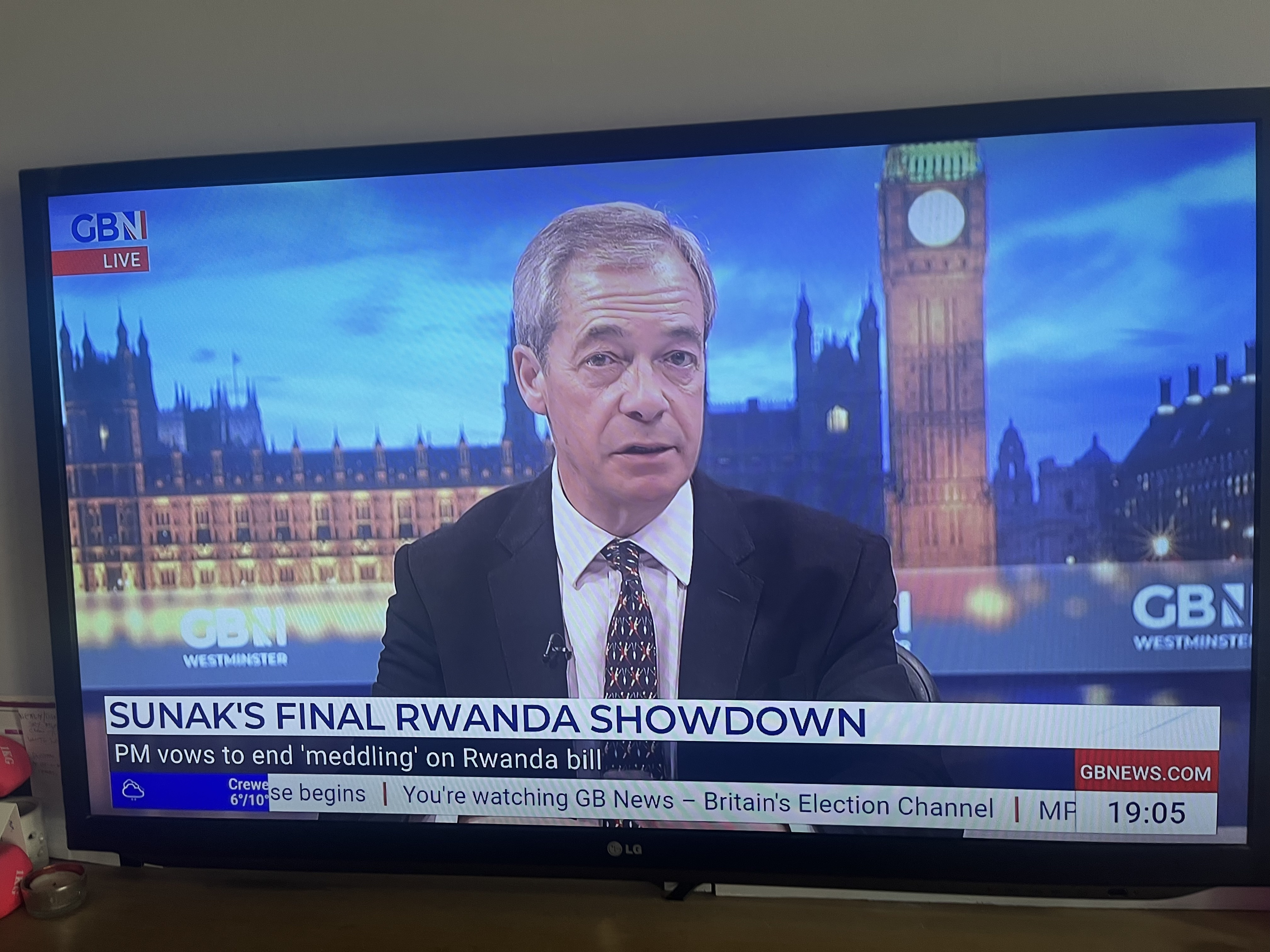
So if Farage stood down from Reform UK and focused on covering the General Election for GB News would he run into trouble with Ofcom rules on GB News which now calls itself ‘Britain’s Election Channel?
To look ahead at what might be possible I first monitored his current output for a fortnight . Farage regularly echoed Reform UK’s attacks on Rishi Sunak’s ‘Brexit failures’ asking viewers ‘why do we believe a word they say’. For the past two nights Farage has quoted from what he calls his ‘Rwanda Files’, apparently leaked documents from the Home Office. He says that Sunak ‘wilfully deceived the nation’ over ‘Stop the Boats’ when he said in March last year that under the Illegal Immigration Bill immigrants on boats would be removed from the UK ‘within weeks’. Farage says the Home Office knew that couldn’t happen. After his first attack there was no coverage on his programme of any response from the Prime Minister or the Home Office, the second night saw a one paragraph quote from the Home Office.
The most common ‘Farage’ format is best described as the “I agree with Nigel’ nights:
Opening monologue; a familiar narrative of illegal immigrants and the crimes some have committed, the shortcomings of the Government’s Rwanda Bill and Britain’s ‘exploding population’.
An interview with a GB News correspondent who plays a relatively straight bat on an issue of the day.
Interviews with experts: these are not the ‘fruitcakes and loonies and closet racists’ who David Cameron once said comprised Farage’s UKIP party. They are Daily Telegraph correspondents, former army officers and chaplains to Queen Elizabeth. What they have in common is that they agree with Nigel. Sometimes they tell him that and sometimes he tells them.
Captions summarising the reaction of viewers so far, normally three people who agree with Nigel.
A second monologue, titled ‘WTF’, in which Farage attacks his usual suspects such as the EU, Prince Harry and ‘senile’ Joe Biden.
The irony about this format is that the rare occasions when a guest completely disagrees with Farage produces the best television. Labour supporter Scarlett MccGwire refuted his claim that the anger of Muslim voters over Gaza could be the start of ‘sectarian politics’ in Britain and damage Labour. She replied that ‘you are much more dangerous’ for the Conservatives because ‘you are going to make sure they lose the election’.
During my monitoring there were fewer interviews with MPs than I expected. Over the period I counted six Conservative MPs being interviewed by Farage, all were Brexiteers, but there were no Labour or Liberal Democrat MPs.
That kind of imbalance wouldn’t previously have been countenanced by broadcasters or allowed by regulators but the current Ofcom regime have emphasised the freedom which they are currently giving to broadcasters to provide impartiality in their own way.
In the podcast interview Farage emphasised the editorial freedom which he’s been given by GB News. So what could a Farage election campaign programme look like ?
1. Ofcom say that during election campaigns ‘It is not acceptable for presenters to use their position to encourage and urge voters to support political parties or candidates’. Farage is smart enough to avoid the call to action which got Talk Sport presenter James Whale into trouble with Ofcom during the Mayor of London election in 2008:
‘if people did not vote for Boris Johnson then they had only themselves to blame if “Livingstone gets in for another term”.
2. Ofcom also say ‘Due weight must be given to the coverage of parties and independent candidates during the election period’. GB News could solve this by extending the news bulletin that precedes Farage’s show to include more campaign coverage clips.
3.Since Ofcom seem to have no problem with the ‘I agree with Nigel format’ expect more ‘experts’ who tell Nigel, as one did during my monitoring period, ‘you’re quite right’.
4. The biggest change to the Farage status quo would have to be the selection of guests from political parties: 6-0 to the Tories won’t wash in an election. And Reform will certainly expect a say.
So there’s a possible template, now Farage has to make his ‘either Reform or GB News’ decision: either campaign for Reform and lose friends in the Tory Party by costing them votes or stay on air on GB News building an even bigger profile and preparing for a future Tory leadership election.
The most prominent initials in the documents released on January 30 are LPP, that’s Legal Professional Privilege. It appears on no fewer than 1,737 of the 10,101 pages, and that’s not including when it is expressed in a longer form as ‘Legal Privilege -s42’ a reference to Section 42 of the Freedom of Information Act which provides confidentiality for advice from lawyer to client.
The BBC has held back from public view hundreds of pages of internal emails covering crucial moments in its handling of the so-called ‘Bashirgate’ affair. They have long said that they would withhold entirely approximately 300 emails for legal reasons. I’ve no way of confirming that that’s the number they’ve withheld but reading through the files you encounter page after page of LPP.
This tactic is a very big bet by the BBC. Until now it has not had to explain these redactions to anybody but In the next stage of the legal process, which is scheduled to come to a head in March or April, it will have to provide justifications to a judge. If he disagrees with their rationale the hidden emails may become public. The most persistent campaigner for transparency, Andy Webb of Blink Films, will certainly be pressing for that.
One crucial test will be whether the redacted communications were made for what the Information Commissioner’s Office calls ‘the dominant (main) purpose of seeking or giving legal advice’. So, for example, does a group email between BBC executives count as ‘legal advice’ because one of the participants was an in-house lawyer.
As a result of all the redactions it is impossible to come to any firm conclusion on the BBC’s handling of the release in 2020 of key 1995 and 1996 documents about Martin Bashir’s interview with Princess Diana. The three months covered in 2020 focus on the autumn when 3 rival broadcasters, ITV, Channel Four and Five , prepared programmes for the 25th anniversary of the interview. The BBC which in 2007 had said it didn’t have any documents and then said in June 2020 that it did but wouldn’t release them, now decided to release some. But beyond that it went from ‘the BBC does not intend to take any further action on events which happened 25 years ago’ to appointing a former judge, Lord Dyson, whose report was damning about Martin Bashir’s conduct back in 1995. Quite a policy shift. So if, as most people now agree, there was a cover-up back in 1996, was there an attempted cover-up in 2020 which began with ‘tell them nothing’ but under pressure ended with ‘let a Judge find out’?
We can’t be sure because of the withheld documents, there is certainly no firm evidence of it so far.The only hint of any ‘smoking gun’ is in an email from a BBC solicitor to a former BBC executive alerting him on the 19th October 2020 that documents in which his name is mentioned are about to be released that day. The key sentence is ‘we are not releasing all of the internal investigations documents at this present time’ which implies the BBC knew there were documents which would not be released.
The other key takeaway after my reading of the ten thousand:
In 1996 BBC executive Anne Sloman wrote an internal note after reviewing how Martin Bashir had got his exclusive interview with Princess Diana. She concluded: ‘The Diana story is probably now dead, unless Spencer talks. There’s no indication that he will’.
25 years later BBC bosses clearly didn’t heed that warning. They failed to pick up the warning signs that Princess Diana’s brother was going to talk and very loudly at that, and the Daily Mail would help.
On 21st October 2020 film-maker Andy Webb, commissioned by Channel Four, emailed Charlotte Morgan in the BBC Press Office. He set out the BBC’s traditional account of what happened back in 1995 and went on:
‘We have recently spoken with someone intimately connected with these events and have received a different account. Our information is that at an 11.30 am meeting at Althorp on August 31 1995 Earl Spencer was told by Mr Bashir that he, Bashir, had a contact within MI5 who had important information regarding surveillance of Princess Diana’.
Webb set out a series of facts as revealed to him by ‘our source’. He never named the source but it must have been obvious to any reader that these details could only have originated from Earl Spencer. Webb ended by asking: ‘ Given the many conflicting versions of what really took place, and as you have pointed out, the historic importance of the Panorama broadcast, has the BBC given any consideration to a full independent inquiry to determine what actually happened? ‘
In the BBC Press Office Charlotte Morgan seemed to understand the implications. She circulated Webb’s email to 8 top BBC people including Phil Harrold, Chief of Staff to DG Tim Davie. Harrold seems to have been the ‘go to’ person in the email chains. She added a covering note:
‘ What timing. Sorry to disturb your evening’s viewing. Channel 4 are not letting this rest. They have a ‘source’ (who seems very well connected to Earl Spencer), challenging our timeline and calling for a ‘full independent inquiry’. I mean what can we say beyond that a quarter of a century on, we can only go on contemporaneous BBC records, as we made clear to them previously, and with the testimony of the Princess herself, in the form of her note? Clearly we need to discuss. Charlotte’. Phil Harrold replied: ‘No worries,I’ll arrange a call for tomorrow’ .
There are no released emails about what was said and decided on that call or what was discussed with Tim Davie, but at 1158 on October 23. Charlotte Morgan emailed Andy Webb ‘‘the BBC does not intend to take any further action on events which happened 25 hears ago’. The request for an independent inquiry was ignored, the BBC was not going to budge.
Later that day, at 15.01, Lord Spencer emailed Tim Davie for the first time setting out his detailed case against Bashir. He concluded: ‘If you agree that something needs to be done, now, then I look forward to hearing from you as to what you might propose. Yours sincerely, Charles Spencer’.
An email thread between the two men began in which over the coming weeks, step by step, the BBC would have to back down from its ‘do not intend to take any further action’ position and eventually agree to an independent inquiry.
Towards the end of the correspondence, on 3 November, Phil Harrold circulated a draft of Davie’s proposed next response to Spencer. It contained the line: ‘I am also happy to meet with you, along with senior editorial executives who are close to these issues, to discuss this directly.’
In the eventual email this was watered down to ‘If you would like to put more to us, I would be happy to engage further’. Tim Davie never met Earl Spencer.The BBC must now be reflecting on whether, despite that warning from history, they missed a key opportunity.
This is not the end of the story.
The BBC now has until Tuesday February 13 to explain in detail to the tribunal judge why it has withheld so many emails for legal and other reasons . Andy Webb then has until February 27 to challenge their arguments.
The tribunal has the right to inspect text which has been redacted by the BBC.
Eventually there will be a hearing sometime after March 11.
If any emails are ordered to be released that probably won’t happen until the end of March.
One other legal option is for the BBC to appeal against the tribunal’s finding and take that to a higher court.
There is a lot at stake for the British Broadcasting Corporation.
The battle between Margaret Thatcher’s government and Arthur Scargill’s union is rightly regarded as a turning point in 20th century Britain. So it is no surprise that it has been revisited, reviewed and re-enacted in British TV documentaries and drama.
Having seen most of them and appeared in a few, ’Miners Strike 1984 – the Battle for Britain’ gets my vote as the best yet. This three part series for Channel Four, filmed and mostly directed by Tom Barrow for Swan Films, is being scheduled on Thursdays at 9pm and all the episodes are already available online .
The films focus on ‘three powerful stories’: the divisions in the Derbyshire village of Shirebrook where striking and working miners came to blows, the ‘Battle of Orgreave’ and the subsequent attempt to jail miners for ‘riot’ and the story of the businessman David Hart who once told Margaret Thatcher ‘victory is yours and yours alone’ and set out to make it happen for her. As Thatcher’s adviser on the black arts of propaganda he helped organise and fund the working miners committee which successfully campaigned to get striking miners back to work.
While I was Editor of Channel Four News (C4N) the Miners Strike from 1984-5 was the story that first proved the value of a primetime hour of TV news every weeknight. We sent reporter Jane Corbin to live in Shirebrook and her work is revisited in the first part of the new series. We also sent camera crews to stand alongside the pickets at Orgeave, other news programmes chose to stand behind the police lines. As for David Hart, the focus of the third part of the series, I met him once in strange circumstances..
In August 1984, five months into the strike, Channel Four News planned a live TV debate between the leaders of the National Coal Board (NCB) and the National Union of Mineworkers (NUM). Such encounters were extremely rare but at C4N we had built a reputation for serious coverage of the issues and both sides had a degree of trust in us, Arthur Scargill was quick to agree to represent the NUM and the NCB put forward their Director of Industrial Relations, Ned Smith, a former miner. Scargill would be live from Leeds and Smith would be on a live link from NCB HQ in London. The C4N presenter, Peter Sissons, a former ITN Industrial Editor, was an obvious and perfect choice to chair the debate .
There was a lot of media interest in who would come out on top in the debate and the Government helped to brief Ned Smith. As I went into work on 22nd August 1984 all seemed organised for the big event and I was certainly not prepared for a mid-afternoon call from the NCB Press Office: ‘Stewart, I think you’d better come round to the Coal Board. I can’t say any more at the moment’.
As I arrived at the NCB I caught sight of Ned Smith leaving the building, and from his body language it looked as if he was in a huff. I was told he was getting a train home. Not exactly what I was expecting a few hours before the biggest TV event of the strike so far. My assumption was that the live debate was off for some reason but surely the Coal Board wouldn’t just pull out at the last minute handing a PR victory to Scargill. Wondering around the NCB offices half-hoping that someone might just turn up to appear live, I discovered that the Coal Board would be represented by none other than the Chairman himself, Sir Ian MacGregor. “I will do it myself” he told me.
A Scot by birth, a U.S citizen by adoption, an industrialist toughened by confrontations with American unions he had been recruited to sort out British Steel and then assigned by Margaret Thatcher to confront coal.
Half of me was delighted, C4N would pull off a real scoop, MacGregor and Scargill exclusively together live. The other half of me was worried, a few weeks before I had made a film with MacGregor to present his view on the dispute. At the same time a young producer called Michael Crick produced a film with Scargill. It was no contest, Scargill was a much better performer than MacGregor who seemed to have trouble reading a script. I wondered if he was dyslexic.
As we approached transmission at 7pm I discovered that earlier that day there’d been a mighty row between MacGregor and Smith with multiple changes of mind about who would appear for the Coal Board. Now the hard reality was that we were about to go on the air with an inexperienced and unprepared TV debater on one side. No wonder Scargill seemed pleased when told of the change of opponent. But as MacGregor and I walked into the makeshift studio at the NCB, I realised the Chairman was not going to be without a bit of help.
For there stood a man I had never met before, who was never introduced, a mustachioed, balding figure clutching a set of cue cards. I later discovered he was David Hart, an adviser to both MacGregor and Thatcher. In the short time he had to prepare the Chairman Hart had hand-written phrases on his cue cards for MacGregor to read out Hart himself said nothing, he just stood off camera shuffling his home made cue cards.
Once Sissons began the questioning MacGregor, sweaty top lip glistening under the TV lights , would sometimes look to the side of the camera to read what Hart wanted him to say but at other times was confident enough to fly solo. It was never in doubt that Scargill would navigate himself and be more fluent and so it turned out. Both men began each answer strongly but then got lost in the details, it was MacGregor who got most lost. The exchanges made it clear just how much they disliked each other.
To wrap up the debate Peter Sissons observed that the general public would conclude that these two men had no common ground whatsoever and would ask ‘what are we to make of it?’. Neither respondent had a convincing answer.
The encounter made news for the fact that it had happened at all rather than what anybody said. It proved there was no way to bridge the gap other than for one side to eventually knock out the other. Seven months later as more and more of the striking miners became working miners the NUM gave up and went back to work. David Hart’s work was done, Margaret Thatcher had her victory.
Extracts from the debate are available to view on the Getty Images news archive website gettyimages.co.uk. To see the first extract type in 1447914031 and for the second extract type in 1447914076
It was an unusual comment for a Culture Secretary to make even if it was ‘just said in passing’.
It came during an interview by Amol Rajan with Lucy Frazer MP on Radio Four’s Today programme at 07.33 on 22nd January. The peg was her announcement that morning that as part of the mid-term review of the BBC’s Charter, Ofcom would be given powers to regulate BBC content online..
Answering a question which was actually about the impartiality or otherwise of the GB News channel, Ms Frazer pivoted to say that the BBC had covered her policy statement ‘in different ways so far that morning’. Challenged by him to clarify what she meant she said ‘i just happened to notice, which I just said in passing, the way it has been chopped up during the course of the morning, has sometimes put the BBC’s perspective forward, sometimes put the Government’s perspective forward, I just thought that was an interesting remark’.
‘Fascinating’ replied Rajan before ending the interview.
Listening back to the hour and a half of the Today programme which preceded the interview I could find nothing which amounted to ‘chopping up’ her statement other than the journalistic craft of summarising long documents in an accessible way.
So in Today’s news bulletin at 0600, the news summary at 0630 and the Culture correspondent’s report in the 0700 bulletin there were references to the DCMS statement about extending Ofcom’s powers of regulation to include BBC online content and also the BBC’s response. I could see no bias in the way this was presented.
What was more noticeable about the BBC coverage that morning was the contrast with its counterparts on ITV and Sky News.
This line was picked up in the review of the papers at 06.09 but not in any of the news bulletins or, most importantly, with Ms Frazer in the interview. Instead Amol Rajan spent much of the interview asking about the future of the licence fe, a subject not covered in the Government’s announcement. Conscious of this, half way through the interview the Culture Secretary pivoted to the issues raised in her statement.But still Rajan did not pick up on her comments in the Telegraph.
By contrast Kay Burley on Sky News asked Ms Frazer if she shared the view, alleged to be held by viewers, that the BBC was not sufficiently impartial. Ms Frazer replied: “I think that on occasions it has been biased.
“We have seen recently it’s had to apologise for its own reporting in relation to the attack on the hospital in Gaza”.
When asked for evidence of bias and whether the BBC’s story was biased or a mistake, Ms Frazer struggled. “The evidence of bias is what audiences believe is the content of the BBC”. She believed perception was evidence.

 ProfPurvis