Who did the first TV coverage of the Post Office scandal?

SECOND THOUGHTS BLOG 9/1/24

ITV is quite rightly getting credit for waking a wider world up to the Post Office scandal with the drama ‘Mr Bates v the Post Office’. Now I discover that an ITV regional news bulletin in the South of England provided the first TV coverage of the problems sub- postmasters were having as a result of the Horizon computer system.

On February 2nd 2008 Meridian News reported on what 15 years later would turn out to be one of the most memorable episodes in the drama:

A postmistress who admitted fraud has walked free from court – after villagers came to her rescue. Jo Hamilton had called a meeting to explain to neighbours in South Warnborough near Basingstoke why cash had gone missing from their post office. She said couldn’t cope with the computer system. Well, the village soon rallied round, and raised thousands of pounds to help pay the money back’.

It appears the next broadcast was in September 2009 when S4C covered the Post Office scandal on a series called ‘Taro Naw’. The programme reported on the case of a jailed Anglesey sub-postmaster and wondered whether there were more cases ‘across Britain’. It is now available again on iplayer here with English subtitles here

The first BBC coverage I can find was three years later also in regional programming in the South of England, on Tuesday 7 February 2011. 

At 7.05 a.m BBC Radio Surrey Breakfast transmitted:

BBC Surrey Jingle: “BBC Surrey. With Nick Wallis.”

Good morning. You’re about to hear a special investigation by BBC Surrey Breakfast. In November last year, a listener called Davinder came to me in a bad way. His wife Seema, who was a Postmistress in West Byfleet, had been sent to Bronzefield Prison in Ashford for stealing more than £70,000 from her own Post Office. In a very emotional phone call, Davinder told me his wife had never taken a penny from the business, but had fallen foul of a problem with the Post Office’s computerised accounting system.’ 

That evening BBC 1 South broadcast an investigation by the same journalist, Nick Wallis, in the Inside Out regional TV documentary strand. The billing was: 

‘A special investigation by the Inside Out South team into the sub-postmasters who have fallen foul of the Post Office’s Horizon computer system’. 

You might think that in the light of the extraordinary interest now created by the ITV drama the BBC might now consider putting the regional Inside Out report back on the i-player. After all it is available on youtube.

But raising its profile on iplayer might risk reminding viewers that the Inside Out strand was scrapped amidst controversy in 2022. 

The Press Gazette reported then:

‘The BBC’s director of policy has said the refresh of its regional current affairs programming which is resulting in the cancellation of Inside Out is “long overdue”.Clare Sumner told Ofcom that Inside Out, which was cancelled with the loss of 29 jobs this year as part of plans to save £25m across BBC England by March 2022, was no longer making the same impact it did when it launched almost 20 years ago.Its audience has been in decline for ten years, she said’.

ITV’s Meridian News in the South of England followed up their original coverage in December 2014. They reported that ‘now postmasters and postmistresses across the South have gained the support of their local MPs’. Former postmistress Jo Hamilton and local MP James Arbuthnot were interviewed.

A few years after the 2011 BBC regional broadcasts Nick Wallis got network showings for reports he made for The One Show on BBC 1 in 2014 and a special UK wide Inside Out in January 2015. Panorama picked up the network current affairs baton with John Sweeney’s ‘Trouble at the Post Office’  in August 2015 and Nick Wallis’s own Panorama in 2020. The sub-postmasters told their story in another Panorama ‘The Post Office Scandal’ in 2022. Wallis was also commissioned to present a radio/podcast series for BBC Radio 4 last year, he was an adviser to the ITV drama and has been freelancing on different news outlets since the ITV drama began. 

Next up for Nick Wallis; more than 20 dates, starting at the Marine Theatre,Lyme Regis on 23 March, for his one man show ‘Post Office Scandal -the Inside Story’ . Some real life versions of the characters you saw in the drama have agreed to answer questions, as has what Wallis calls ‘a major anonymous source in my book’.

SECOND THOUGHTS 22/12/2023

THE BBC’S ‘BASHIRGATE’ COUNTDOWN CLOCK IS TICKING.

At the BBC the countdown is underway to a crucial moment in so-called ‘Bashirgate’, one that goes to the heart of how the current BBC Executive have managed recent developments in the affair. The tribunal which hears contested Freedom of Information cases has set a deadline, believed to be January 24th, for the BBC to release documents to journalist Andy Webb.  Last month the tribunal strongly criticised the BBC  for failing to release a large number of emails relating to Martin Bashir’s 1995 interview with Princess Diana on Panorama. It said the corporation had been “inconsistent, erroneous and unreliable”. Andy Webb wants the release of over 3,000 internal BBC emails sent between September and November 2020 . This period includes the dates between Lord Spencer first asking the BBC for an independent inquiry into the events of 1995, the BBC’s initial reluctance and their eventual decision to agree to what became Lord Dyson’s inquiry.

The BBC can only withhold certain documents if it can convince the tribunal in the remaining days that it has the legal right to do so. A release of key documents would make it possible to compare this internal evidence with the public account given by the Director-General Tim Davie in an interview on the Today programme. A transcript is in my timeline of the Bashir affair.

Last weekend it became clear the BBC is facing further potential jeopardy, that it may have committed a criminal breach of the Freedom of Information Act. A spokesperson for the Information Commissioner’s Office said that following a complaint by Mr Webb under section 77 of the Freedom of Information Act the “case has been referred to the criminal investigations team who are currently reviewing the material provided”. Section 77 says ‘any person to whom this subsection applies is guilty of an offence if he alters, defaces, blocks, erases, destroys or conceals any record held by the public authority’.

This review would be a first step before any more detailed inquiry by the criminal investigations team. Investigation is a most unusual step, there has only been one previous conviction for the offence which carries an unlimited fine.

CAN BROADCASTERS CAMPAIGN?

As a regular critic of Ofcom for what I believe is its failure to enforce the impartiality rules on GB News,  I now believe it has gone too far the other way.

Let me explain. Cast your mind back to the General Election election campaign of 2017, that’s the one where ‘strong and stable leader’ Theresa May wasn’t as popular as PM as she thought. Throughout the election campaign she had refused to take part in a head-to-head TV debate with Labour leader Jeremy Corbyn. In the next year, 2018, Sky News launched what it called its ‘Make Debates Happen campaign’. The Head of Sky News was interviewed about it on the air and Sky News started a petition ‘for an independent commission to monitor regular leaders’ debates and make them a permanent election feature.’ Jeremy Corbyn supported it,Theresa May didn’t. I was struck at the time by how unusual it was for a broadcaster to run a public campaign which divided on party lines. Ofcom took no action.

Now Ofcom has decided against GB News after a programme which promoted a ‘GB News- branded campaign called ‘Don’t Kill Cash’. This campaign included a petition which called on the Government to “introduce legislation to protect the status of cash as legal tender’.  GB News had argued that the campaign was ‘not about a matter of political controversy or current public policy’.

The decision will leave all broadcasters, not just GB News wondering whether they stand on ‘campaigns’. At ITN I always tried to avoid the word, my advice was ‘call it an investigation’.

‘DORRIES TELLING TRUTH’ SHOCK.

There appears to be growing momentum behind Alan Rusbridger’s admirable campaign to get a proper response from the BBC to allegations that a board member, Robbie Gibb , tried to interfere in the process leading to the appointment of the Chair of Ofcom, which is of course the BBC’s regulator. The issue was raised by MPs during the hearing to confirm the new BBC Chair but Samir Shah didn’t want to comment on it. This month there was also evidence from a source ‘who worked closely with’ Nadine Dorries when she was DCMS Secretary. It was Ms Dorries who first made the allegation against Gibb in her her book ‘The Plot’. The book has been widely criticised for being less than factual  but this particular allegation has never been denied by anybody. Jake Kanter, a widely respected media correspondent now working for the American website Deadline, reports that the source tells him that Gibb “campaigned” for his preferred candidate to become Ofcom chair

.

SECOND THOUGHTS 2

How to conclude the BBC’s Lineker ‘psychodrama’

The more that MPs pressed Samir Shah for his views on Gary Lineker’s social media posts the more it sounded like the Chair-Elect of the BBC didn’t just think the football presenter had broken the rules Samir Shah wanted the system changed less than three months after it was announced.

“We need to find a solution to this”  he told his fourth questioner on Lineker, Clive Efford MP, at the pre-appointment hearing of the Culture Committee. “It has being going on for too long and it may be that the social media guidelines once again need to be looked at to make sure we somehow get this out of the public eye’. Dr Shah wanted to bring an end to what he called a ‘psychodrama’. 

Don’t criticise the character of individual politicians in the UK’ seems a clear enough piece of BBC guidance to me and I’m not sure changing it would ‘get this out of the public eye’. The real choice is between enforcement and abolition.  The enforcement guidelines say  ‘For contract freelancers/presenters who are found to have breached the guidance there may be consequences including non-renewal or termination of contract’. But the BBC seems determined to avoid what they would see as a ‘running commentary’ on who has and hasn’t broken the rules and what consequences have followed. We still don’t have the BBC Executive’s judgement on the Lineker posts that their next Chair is so clear about. 

I have long thought the direction of travel is towards freedom of expression within the law for presenters other than those in news and current affairs.That solution may be the only way to conclude the psychodrama.

Are the next BBC Chair and the King on opposite sides in a culture war ?

“I’ve never been involved in any political activity at all. I’ve not been a campaigner” Samir Shah told Damian Green MP who took him through a checklist of any potential conflicts of interest.  Samir may not be a ‘campaigner’ but it is fair to call him a ’culture warrior’. He actively supports an organisation which says it is on ‘the most active front in a new culture war’.  The History Matters project was launched by leading centre-right think tank Policy Exchange in 2021 to ‘document the re-writing of history as it happens’ including the removal of certain statues on public display and the renaming of buildings and places. It claims such ‘action is being taken widely and quickly in a way that does not reflect public opinion or growing concern over our treatment of the past’. Samir Shah has been the Vice-Chair and is still a panel member of the project and he has  criticised institutions which are “far too readily acquiescing to noisy activism”. History Matters regularly lists examples of ‘what is happening’ without offering any judgement on them. The October 2023 ‘project compendium’ includes such undeniably woke events as an autumn festival at Kew Gardens ‘to celebrate Queer Nature’ but I was surprised to see Item 14 .’King Charles supports research into the Royal Family’s slavery links. The Palace have given researchers full access to the Royal Archives and the Royal Collection to investigate the family’s historic ties to slavery….The Palace has said that King Charles takes the issue ‘profoundly seriously’. Surely the Chair-Elect of the BBC doesn’t have a problem with that.

Growing demands for action on election misinformation

A leading expert on broadcasting regulation has warned that Ofcom may not have the right skillset to cope with the flow of fake news during the next General Election. Former Ofcom Director of Standards Chris Banatvala told a Voice of the Listener and Viewer conference that such was the innovation in technology that there could be fakery which is “so sophisticated that anyone can get fooled, including the regulator itself”. His warning follows a call by the Government’s chief scientific adviser, Professor Dame Angela McLean ,for a public information campaign before the next election which would warn voters how they could be tricked by AI-powered misinformation.

Chris Banatvala was on a panel on fake news which I chaired which also included Marianna Spring, Disinformation and Social Media Correspondent at the BBC and Chris Morris, CEO of FullFact.The video is recommended for anybody interested in AI and fake news.

Was there a BBC cover-up of the Martin Bashir cover-up? A timeline.

In June 2021 I prepared a new timeline on the BBC’s handling of the Martin Bashir affair which, amongst other issues, examined what the current BBC Director-General,Tim Davie, knew when about Lord Spencer’s 2020 allegations against Bashir. Tim Davie received credit for setting up an independent inquiry under Lord Dyson but information suggests that his decision was not made when he first heard of Lord Spencer’s detailed allegations against Bashir but when subsequent events left him no other option. I built this timeline from the work of investigative journalist Andy Webb and I give full credit to him. I am reposting it unamended on 10th December 2023 after the publication of Andy’s article in the Mail on Sunday ‘BBC bosses who fought to keep thousands of documents linked to Bashir’s infamous interview with Diana under wraps have questions to answer’.

28 March 1996

This is not the conventional starting date for a timeline about Martin Bashir’s BBC Panorama interview with Princess Diana, after all the programme was transmitted in December 1995. 

But think of this date as the day somebody senior at the BBC realised something was wrong and raised an alarm.

Tim Gardam was the Head of Weekly Current Affairs, a man so intellectually gifted that when I interviewed him for the job of my successor as Editor of Channel Four News a decade earlier, my boss at ITN, Sir David Nicholas, suggested we had just met a future Director-General of the BBC. But we didn’t give him the job at ITN, nervous that when he said he ‘didn’t suffer fools gladly’ he meant it a little too much. Tim Gardam was subsequently appointed as Head of News and Current Affairs at the soon to be launched Channel Five and March 1996 was to be his final month at the BBC.

As Head of the Programme Department which had produced the Diana interview Gardam was asked to investigate allegations in the Mail on Sunday that Bashir had shown faked documents to Princess Diana’s brother, Lord Spencer.

Gardam wrote out in his own handwriting a record of what he had discovered and gave it to the office of the then Head of BBC News Tony Hall, later Lord Hall Director-General of the BBC. Gardam recounted how early on Bashir accepted that had asked a graphic designer to create faked documents, the preferred wording in the BBC became ‘graphicised documents’, but repeatedly denied to Gardam that he had shown them to anybody. After the Mail on Sunday pressed their allegation that he had shown them to Spencer, Gardam tried to get hold of Bashir again. Here is what he wrote at the time of his next conversation with Bashir:

‘he rang me and told me for the first time that he had shown, despite his specific denials on December 21st, and that morning, the graphicised documents to Earl Spencer’.

Gardam went on: ‘I told Bashir that this overturned every assurance the BBC had been given + the BBC would have to consider its position’. 

This was a crucial moment, a BBC executive had discovered that Bashir had lied to him a number of times. Gardam later said: “It would never have occurred to me that a BBC journalist would lie to produce something to deceive someone, and then at the same time to lie to his editors and managers”.

According to Lord Dyson’s report, Tim Gardam completed his handwritten report, dated it 28 March 1996 and ‘and gave it to the office of Lord Hall’. It was in effect a handover note before he left for Channel Five. The statement was significant enough for Gardam and Tony Hall to agree that ‘the BBC needed to find out the entire truth behind Bashir’s activities’. Hall conducted that further inquiry himself with Gardam’s successor, Anne Sloman, an inquiry which Dyson was to call ‘woefully ineffective’. 

When Hall later reported to the BBC Board of Governors he never mentioned this proven example of Bashir’s lies or that Bashir had breached the BBC guidelines. In fact he told them Bashir was an ‘honest and honourable man’.

It would be over 25 years before the public knew the Gardam statement existed. In fact at the next stop on this timeline the BBC specifically said it or anything similar did not exist.

APRIL 2007

The investigative journalist Andy Webb, a former BBC television reporter, submitted a Freedom of Information (FoI) request to the BBC for the files on the Bashir affair. He was told by the BBC there were no documents on file. The BBC reply said:

‘Any meetings to discuss this particular programme would not have been minuted and the number of people involved in the process kept to a need-to-know basis only’.

JULY 2020 

Andy Webb tried again. He submitted a new FoI request. The BBC changed their view about the existence of relevant documents. ‘We should have taken steps to ascertain whether relevant information was held. We apologise that this was not done, and that the answer you received was inaccurate’.

19 October 2020

The BBC released some documents to Andy Webb under Freedom of Information. The Gardam note of 28 March 1996 was not among them but a new chain of events was begun which continues to the present day.The release came too late, possibly deliberately too late, for Webb’s documentary scheduled for two days later on Channel Four,

20 October 2020 

Andy Webb decided to share with Lord Spencer one of the documents released by the BBC. Spencer was shocked by what he saw. This is what he later told Lord Dyson:

‘What I saw was utterly astonishing: a snippet from the Tony Hall report of April 1996, in which I seem to have been accused (in a heavily redacted passage) of having shown Bashir fake bank accounts to Alan Waller. I was outraged: I had done no such thing; and to make the lie worse, the BBC seemed to be falsely claiming that I had given Bashir the idea to resort to using his own fake bank statements’. 

Spencer reacted by outlining to Webb his most serious allegations against Bashir, the first time he had set them out. 

21 October 2020

Webb passed on Lord Spencer’s allegations to the BBC in a detailed, private, note. These allegations involved Bashir’s use of forged bank statements, his claims that Princess Diana’s staff were agents for MI5, and that a plot existed to murder the Spencer family.

Andy Webb asked the BBC whether, in light of these very serious allegations, the BBC would consider ordering an independent inquiry’.

23 October 2020

Charlotte Morgan in the BBC Press Office replied to Andy Webb that: The BBC does not intend to take further action on events which happened twenty-five years ago.’

On the same day as the BBC reply, Lord Spencer emailed the Director-General of the BBC, Tim Davie, asking for a full inquiry. 

An email conversation began between the two of them. The details of most of these emails have not yet been released but we do know the content of one.

28 October 2020

Tim Davie emailed Lord Spencer: ‘You say the BBC’s sequence of events is incorrect and that Mr Bashir had shown you the documents before you had introduced him to the Princess of Wales. Unfortunately, the account you give does not accord with the account that Mr Bashir gave the BBC at the time. Our records show that he told us that although he had mocked up the statements before the Princess of Wales agreed to give the interview, you had already introduced them to one another and the relationship was therefore established. With Mr Bashir indisposed, unfortunately the BBC can only rely on what our historic records show’.   

It was now eight days since the BBC was made aware of the detailed allegations by Lord Spencer. Rather than propose an inquiry of any kind, their initial response was ‘to take no further action’ and their second response – specifically from the BBC DG – was that nothing more than be done for the time being. Their phrase ‘the BBC can only rely on what our historic records show’ would prove to have a sting in the tail. 

1 November 2020 

An unconfirmed timeline published by the Metro newspaper says that on this date: ‘Following Earl Spencer’s claims, BBC Director-General Tim Davie is thought to have apologised for the false statements. He reportedly wrote to Earl Spencer to make the apology but declined to open an investigation into Bashir’s conduct’. The Daily Mail also reported that doing this period Davie offered Lord Spencer a ‘piecemeal apology’. 

After the response from Tim Davie to his emails, Lord Spencer is  believed to have concluded that he had taken the private dialogue with the BBC as far as he could. He would now air his allegations in public.

2 November 2020

Lord Spencer emailed Davie enclosing a copy of a fax signed by Bashir, making lurid allegations against Tiggy Legge Bourke.

3 November 2020

The first Daily Mail front page appeared, detailing Spencer’s evidence of Bashir’s campaign of lies.

4 November 2020.

A BBC spokesperson said the corporation was happy to apologise again to Lord Spencer and promised to investigate any ‘substantive new information’. The BBC added: ‘We have asked Earl Spencer to share further information with the BBC. Unfortunately, we are hampered at the moment by the simple fact that we are unable to discuss any of this with Martin Bashir, as he is seriously unwell. When he is well, we will of course hold an investigation into these new issues’.

6 November 2020

In an interview with the BBC Radio Four programme ‘Today’ I called for an independent element in any BBC inquiry. I rejected the notion that such an inquiry had to wait for Bashir’s recovery from ill health, pointing out out that a review of the BBC’s documents could begin immediately.

The BBC later announced publicly for the first time that an inquiry would be held.

18 November 2020.

The BBC announced that a former Supreme Court Judge, Lord Dyson, would conduct a fully independent inquiry.

20 May 2021.

The BBC published the report by Lord Dyson and said ‘We recognise that it has taken far too long to get to the truth’. Tim Gardam’s statement of 28 March 1996 was published for the first time within Dyson’s report. It was a significant element proving that the BBC had established as far back as 1996 that Bashir was a proven liar. In his cross-examination of former BBC executives Lord Dyson often referred  to Gardam’s statement. 

25 May 2021

Tim Davie was interviewed by Justin Webb on the Today programme. Here are some extracts:

Webb: When did you first know that Martin Bashir had lied about these documents?

Davie: Um personally,(hesitation) I think I knew when I read Dyson, Im sorry Im not being evasive, because I’d heard the claims of Earl Spencer. Id read reports but when I knew it was when I got that Supreme Court judge to go and do the analysis and talk to everyone.

Webb: Different question then, when did you suspect it?

Davie: When I saw evidence coming to me that was firm evidence that there was clearly things that had gone horribly wrong in that investigation. If you look at what happened in late October documents were emerging and Earl Spencer put them into the public domain, they clearly indicated there were bigger problems with this investigation, that were known about and within days we had announced an investigation.

Webb: You say documents were emerging, it was a Channel Four documentary wasnt it and the point made by the documentary-maker is that the documents that he asked for were given to him two days before he made the documentary, this is October last year, in a way that must have been down could not be included in the documentary. He thinks that was deliberately done.

Davie. It wasnt.

Webb: So on your watch, everything has been done as openly as you would like.

Davie; I think we have acted appropriately and openly and responded in the right way.    

Webb: So when the BBC issued a statement saying As Managing Director of News Mr Hall fulfilled his management responsibilities’ , this statement issued last November, that was with your approval?

Davie: We absolutely had to judge things on the facts we had and thats what we did. 

Webb: You had the facts then didnt you, you had the facts presented to you, you knew perfectly well that Mr Bashir had fraudulent documents, you knew perfectly well the background within the BBC , theres no questions about that is there?

Davie; No but within days of getting substantive evidence we absolutely , Justin I cant have been more robust personally to have called in a Supreme Court Judge, until you get to that point you deal with what youve got. As soon as I had substantive evidence .. ..I have to say no other organisation in the world, in terms of the BBC ,we hold ourselves to account in a way that is unlike every other. ..

Im only interested in getting to the truth’ .

A number of journalists were struck by how uncomfortable Davie sounded when asked what he knew and when. Repeating a phrase from the BBC’s statement of 4 November he said he acted ‘as soon as I had substantive evidence’. 

But Andy Webb had emailed Lord Spencer’s detailed allegations to the BBC a full two weeks days before the BBC acknowledged the need for any inquiry of any kind and had replied to Andy Webb that The BBC does not intend to take further action on events which happened twenty-five years ago’. When Lord Spencer emailed Davie the email exchange ended with Davie saying that because of Bashir’s illness there was nothing more he could do. The bottom line is that the BBC only acted once the same ‘substantive evidence’ appeared in the Daily Mail.

11 June 2021

A newspaper was about to publish a story about the BBC’s handling of Lord Spencer’d allegations when the BBC Press Office issued a statement to them. It said that Tim Davie had not seen Tim Gardam’s 28 March 1996 statement because it was not in the BBC dossier given to Dyson. If true Davie had not known until Dyson’s report that the BBC had evidence from 1996 of Bashir’s lying.This raised the immediate question of how the statement came to be in Lord Dyson’s report. The BBC didn’t have an answer to that. 

14 June 2021

Lord Dyson’s team confirmed that it was in fact Tim Gardam who had given them a copy of his March 1996 statement. In his report Dyson had said that Gardam had given the original ‘to the office of Lord Hall’ so presumably there can be no doubt that it was once in the hands of the BBC. In fact its existence is mentioned in other BBC documents. So where did it go? Unlike another missing document, the letter from Princess Diana to the BBC, this one was never tracked down. How hard did the BBC try? Just as important how fortunate was it that Tim Gardam still had a copy and gave it to Lord Dyson. Without that copy Dyson would not have got to the truth. It really is as simple as that.

15 June 2021

Three BBC Directors-General, one current and two past, appeared before the Digital, Culture, Media and Sport Select Committee. The Committee said ’Former BBC Director-Generals Lord Hall and Lord Birt will be questioned about events leading up to Panorama’s landmark interview with the late Diana, Princess of Wales, and the broadcaster’s handling of investigations into how reporter Martin Bashir obtained it’.

The current DG ,Tim Davie, and the current Chairman, Richard Sharp, also appeared. Some of the questions put to Hall and Davie appeared to be based on information in this post.

Why all this matters 

The BBC is accountable to licence-fee payers and to Parliament.  That accountability requires proper keeping of documents and, at the appropriate times, proper disclosure of those documents. The events of the past year raise the following twelve questions for Tim Davie:

1.The BBC having said in 2007 that there were no documents to release, who decided in 2020 that some should be released?

2. Who decided which documents should be released?

3. Was the Tim Gardam statement of 28 March 1996 in the BBC’s files at that point? If it was why wasn’t it released, if it wasn’t where had it gone?

4.Do you accept that if Tim Gardam had not kept a copy and given it to Lord Dyson the public would not have been given the full truth?

5. Was the disappearance of this document also one of the reasons why BBC executives don’t seem to have known the full background on Bashir when they re-hired him?

6. Why was this fact not included in the McQuarrie report published on 14 June into the re-hiring?

7.When were you, as DG of the BBC, first aware of the disappearance of the BBC’s original of the Gardam statement and did you consider it significant enough to release that information? 

8. Turning now to Lord Spencer’s allegations against Bashir last October, you have said that you acted  ‘within days of getting substantive evidence’. Do you accept that after the BBC was informed on 21 October of Lord Spencer’s allegations against Martin Bashir your press office said ‘The BBC does not intend to take further action on events which happened twenty-five years ago.’

8. Do you accept that when Lord Spencer emailed you personally with the detail of his allegations an email exchange followed which ended with you  saying : ‘With Mr Bashir indisposed, unfortunately the BBC can only rely on what our historic records show’.  

9, Do you now accept that this statement was flawed because the BBC’s ‘historical records’ did not include the Gardam statement. 

10, Do you accept that you only began to announce and set up any kind of inquiry after Lord Spencer’s very same allegations appeared in the Daily Mail on 2 November ?

11. In what way was the Daily Mail reporting any more ‘substantive evidence’ than the allegations already reported to the BBC on 21 October and emailed you personally by Lord Spencer on 23rd October?

12. Do you accept that rather than act once you had received ‘substantive evidence’ you sought to reach an agreement with Lord Spencer which would involve an apology but avoid an independent inquiry and that you only had to abandon that position after he refused to accept that and went to the Daily Mail. 

Disclosure of Interests: I was a BBC News journalist from 1969 to 1972 . I then joined BBC Newss principal competitor, ITN. While I was Deputy Editor of ITN in the early 1980s Martin Bashir was a freelance producer on the ITV Lunchtime News. I went on to become ITNs Editor and Chief Executive. I subsequently became Ofcoms Partner for Content and Standards where I led the investigations into breaches of the Broadcasting Code by the BBC and other broadcasters. I was a Non-Executive Director of Channel Four for seven years, my term finished at the end of May 2021, but I played no role in the Channels own investigations into Martin Bashir. The views in this post are written in my personal capacity and not as a past director of Channel Four.

Is the new BBC Chair ‘a friend of the Prime Minister’ and some other Second Thoughts on the week’s media news.

‘Samir Shah’ ..he’s one of our own’.

The positive response in the media to the appointment of Samir Shah as the Government’s preferred choice as the Chair of the BBC can partly be explained by relief that the job is going to a media professional not a politician past his or her prime, ‘someone in the City’ or a known party donor. On Sky News Breakfast I welcomed Samir’s broadcasting experience and the fact that he wasn’t ’a public supporter of any particular political party’ or a known donor . I also pointed out that this government does not like to appoint to public posts anybody they regard as ‘woke’ and that Samir has ‘non-woke credentials’

So I was struck by Roger Bolton’s views in his latest ‘Beebwatch’ podcast about how ‘my old boss Samir Shah is to become the new chair of the BBC’. He explained that for the last 3 years of him presenting ‘Feedback’ on BBC Radio Four the series was made by Samir Shah’s independent production company, Juniper. Samir Shah had been the Executive Producer but according to Roger Bolton ‘had made virtually no impression on me at all, we rarely if ever had a conversation and his contribution to the editorial content of the programme seemed to me to be minimal. Perhaps I missed something’ .  

The background is that the BBC announced in August 2022 that a new production company and a new presenter were being chosen for Feedback and reported that ‘Listeners have expressed their anger and disappointment’ at the departure’ of a ‘firm favourite’ who was ‘known for being unafraid to firmly hold BBC senior figures to account’.

On his podcast Roger continued; ‘Samir seemed to spend a lot more of his time on his political interests. He is said to be a friend of the  Prime Minister, Rishi Sunak, who was said to want him to be Chair of the Victoria and Albert Museum…he is well liked in Government circles’. 

I have no other evidence on whether Dr Shah and Mr Sunak are friends.,

Were ITV’s investigations into Philip Schofield ‘considerable enough’? 

Preparing to be interviewed on ITV News on 7th December 2023 about the publication of a summary of the independent report into ITV’s handing of Philip Schofield’s relationship with a runner on This Morning, I noticed something odd.

It is first worth emphasising that what was published was not the report by Jane Mulcahy KC but her summary of her report. She explained that ‘there are a number of aspects of this Review which are highly personal and private to various individuals’ and therefore the report itself is confidential.

At the end of her summary ITV helpfully published the Terms of Reference which they agreed with the KC at the start of her review. 

The first two points are;

1. To determine and set out the steps taken by ITV in 2019 and 2020 to look into the rumours that Phillip Schofield was in a relationship with a member of the Daytime production team (“Person X”).

2. To consider and set out whether these steps were appropriate and adequate in the circumstances, taking into account applicable/relevant policies and procedures in place at the time and having regard to any legal duty of care owed to Person X by ITV.

I have underlined what seem to me to be crucial parts of the Terms of Reference, especially given the allegations by former This Morning presenter Eamonn Holmes that there were ways in which the ITV management could have established the truth much earlier. In particular he alleged that ITV could have checked their transport records to see whether it was true that the runner was collected from Philip Schofield ’s home on Friday mornings.

I then looked at the summary to find Jane Mulcahy’s conclusions on these points. All I can find is:

ITV’s management made considerable efforts to determine the truth about an alleged relationship between PS and PX following on from the publication of a story in The Sun newspaper in early December 2019. However, in the face of the denials of the individuals involved, ITV was unable to uncover the relevant evidence until PS’s admission in late May 2023.

What does not appear in the summary is any further detail of these ‘considerable efforts’. Given her Terms of Reference to ‘set out’ the steps taken by ITV I would have expected a summary list of these efforts, in particular whether at the time of the original rumours ITV did or didn’t check transport records. I would also have expected her judgement about whether ‘ these steps were appropriate and adequate’. There is no such judgement in the summary other than the words ‘considerable efforts’

My own conclusion is that there is no evidence in the summary to indicate whether the KC carried out her full terms of reference. It is possible that the report itself does have more details of ITV’s ‘considerable efforts’ and the KC’s judgment about them but they have not been included in the summary for some reason. If that was the case it could have been explained in the summary.

Before I appeared on ITV News at 1830 and referred to this issue I asked ITV News to raise it with ITV management but I have not heard any response. 

What is the truth on the Government’s broken ‘pledge’ on the license fee?

The BBC World at One news bulletin report on the higher licence fee (7th December 2023) ended ‘It is an increase of  6.7 % which is lower than Ministers had pledged’. That sounded fighting talk so I checked if it was true the Government had broken a pledge.

I found a letter from the then Culture Secretary Nadine Dorries to the BBC in January 2002

‘From the third year of the settlement period (i.e. from 1 April 2024 and for each subsequent year of the period until 31 March 2028), the Licence Fee will then increase annually in line with CPI inflation’.

That seemed to me to imply but not specifically state that the increase would be in line with the annual rate of inflation rather than choosing a particular month’s increase which is what the Government chose to do. But the Government statement openly admits they have changed the rules of the game.

in recognition of the ongoing cost of living pressures faced by families, the government has today decided to change how the inflation-linked uplifts to the licence fee are calculated for 2024….The previous methodology for calculating inflation was the averaged annualised October to September CPI figure of 9 per cent. The new methodology for 2024 uses the annual rate of CPI in September 2023 of 6.7 per cent, and is the approach used to calculate uplifts to benefits’.

Five reasons why the Tories dropped their plan to privatise Channel 4

Officially, the Channel 4 Corporation is an ALB (arm’s length body), Whitehall jargon for owned by the public but not run by the government, one of a shrinking list of businesses on HMG’s books that vary from the Ordnance Survey and The Royal Mint to the banks rescued during the financial crash, plus the company formally known as the Atomic Weapons Establishment. C4 is the only business on that list that does any kind of journalism; the BBC’s Royal Charter puts it in a different category.

So maybe it is not surprising that from time to time the Conservative government of the day picks out C4 from these strange bedfellows and asks if it should sell off this publicly owned, commercially funded broadcaster with annual revenues of around one billion pounds. The latest occasion was the fourth time (that’s by my count, others argue it is the sixth or seventh). So how come every time the Tories ask themselves the same question, they come up with the same answer – don’t sell?

The first prime minister to ask was, ironically, the one who had launched the channel in 1982 as publicly owned but commercially funded. As the BJR revealed in 2021 (Channel 4: the 30 years’ war, Volume 32, Issue 3), Margaret Thatcher thought she had a better idea by 1988: create an even bigger “third force” against the BBC and ITV by merging a privatised Channel 4 with a soon-to-be-created Channel Five. Her plan was floated in a white paper but lacked support inside the Tory party, let alone outside it.

Eight years later, in 1996, John Major was tempted to sell to offset a shortfall from other privatisations. His cabinet voted to explore the idea but opposition within the Conservative Party was symbolised by a “Dear John” letter from the then C4 chairman and Tory supporter Sir Michael Bishop. “For Channel 4, with new shareholders seeking to maximise profits, money for dividends would have to be taken directly from the screen at viewers’ exp, by diverting programme expenditure.” That argument carried the day.

Under New Labour, C4 was safe, and during the coalition years Liberal Democrat ministers acted as a brake on their Tory colleagues. But when in 2015 the Tories won an overall majority, David Cameron appointed as his secretary for culture, media and sport (DCMS) the man who had been Margaret Thatcher’s political secretary during that 1988 debate about C4’s future. For John Whittingdale, this was his chance to complete his former leader’s unfinished business. A civil servant was spotted going into 10 Downing Street with a document revealing that work should be done on “extracting greater public value from the Channel 4 Corporation, focusing on the privatisation option in particular”. Putting aside any mild embarrassment that the previous month Whittingdale had said “the ownership of Channel 4 is not currently under debate”, he seemed to be on course for success.

However, when Cameron lost the Brexit referendum in 2016, Theresa May took over as PM and sacked Whittingdale. An ambitious junior minister called Matt Hancock picked up the C4 brief and used the threat of privatisation to try to extract some “greater public value”. In a compromise worked out with Channel 4 CEO Alex Mahon, the largest C4 office would remain in Horseferry Road, Westminster, but a new site outside London would became the “national HQ” of the channel. Leeds was chosen, and other departments were moved from London to regional centres. This seemed like a deal that could put the privatisation issue to bed for a decade or so.

But as prime ministers continued to come and go, by 2020 Whittingdale was back in a more junior role at DCMS, summoned from the back benches by Boris Johnson, who was developing a thing about the folks in Horseferry Road. Various people in and around the channel weren’t above winding him up either: replacing Johnson with a block of ice when he wouldn’t take part in a party leaders’ debate on climate change, accusing him of sending his father as a replacement when Johnson Senior was actually a guest of the channel, misquoting the prime minister as saying “people of colour” instead of “people of talent”, and finally calling him a liar. Downing Street was keeping the score as it planned its revenge.

“Here we go again,” said media analysts Enders as Whittingdale was given the go-ahead to restart the C4 debate. Trying to leave nothing to chance this time, he began with “the government’s preferred option”, which was to “facilitate a change of ownership of Channel 4”. But the persistent privatiser fell at the final fence again when Johnson fired him in a DCMS ministerial slaughter after the department failed to deliver the Ofcom chairmanship to Paul Dacre. Whittingdale took it badly and was later compensated with a knighthood.

Nadine Dorries was put in charge at DCMS – what could possibly go wrong? Well, her patron at No 10 got fired by his own MPs for starters. When Johnson left, and with him key advisers pushing for privatisation, the C4 parcel was passed to incoming PM Liz Truss. During the campaign for the party leadership, she had fudged her position and once in office replaced Dorries with Michelle Donelan, who promptly described herself as “somebody that listens” and decides policy “based on evidence”. The well-paid advisers to the likely broadcasting bidders feared the gig was up.

Their hopes rose a little when Rishi Sunak became PM because he had declared himself a seller. However, faced with so many other more pressing problems, Downing Street allowed Donelan at DCMS to conclude that not only was the status quo the option to take but that C4 should also be given something it had never asked for over 40 years: the right to make and sell some of its own programmes.

The campaign to privatise C4 had got closer to legislation than any previous attempt, so what caused this remarkable last-minute change of policy?

1. The political roundabout

The sale of Channel 4 has been considered over the years by no fewer than seven Conservative prime ministers and 17 cabinet ministers who held the media brief. How many were in the job long enough to understand the detail? Margaret Thatcher and John Whittingdale, for certain, that’s clear from the his and hers 1988 papers in the National Archives. But how about Nadine Dorries, who told a Commons committee that Channel 4’s future should be “brought into question, particularly when it is in receipt of taxpayers’ money”. Channel 4 receives no taxpayers’ money.

How many were in the job long enough to care? When the ministerial stars were in alignment for the zealot partnership of Boris Johnson and John Whittingdale and then the Johnson/Dorries coupling, there was strong momentum towards a sale, and a hasty consultation was organised to make the parliamentary timetable as fast as possible. When Whittingdale fell, ironically at the hands of Johnson, and then Johnson himself fell, there were few left who thought the issue was worth a lengthy and potentially difficult parliamentary process. The musical chairs paused for a moment and somebody had to make a decision. Those who supported what C4 had done for the Paralympics and other good deeds (one cabinet minister even stood up and sang Happy Birthday at a C4 party), combined with the “don’t knows” and the “don’t cares”, turned out to be in the majority. Even the lead presenter of Channel Four News being caught calling a minister a “c***” off air was forgiven.

2. The limpness of the ideological argument

The base case for privatisation was once summed up by Whittingdale: “It’s worth asking the question why we need two publicly owned broadcasters.” The simple answer is that the BBC and Channel 4 have different roles. But how could the private sector best perform C4’s duties around innovation, creative risk-taking, and championing unheard voices? A radical alternative would have been a challenge to the free market; maybe language such as “we will deregulate Channel 4 allowing private capital to create innovative new services” and, of course, at the same time maximise the revenue for the Treasury from the sale. Instead, the Government went with the public service broadcasting status quo, sweetened only by a hint of “modernisation of Channel 4’s remit and obligations”. It was a pitch to the consolidators, such as ITV, Viacom (owner of Channel Five) and Warner Brothers Discovery, to increase their scale in the UK, run their own programmes on C4’s channels and, most importantly, take C4 off the Government’s hands. But would it be worth the bother?

3. The failure of the business case

Back in 1996, Whittingdale was arguing that Channel 4’s healthy financial position – annual surplus of £128million – meant it was time for “privatisation at the first opportunity”.

By 2016, he said privatisation was necessary because despite the financial position (£26million surplus and record revenues), C4 might not be sustainable in the long term. After the pandemic, the 2021 surplus was back over £100million, backed up by net cash reserves of £272million. Surviving Covid had been the incentive for cutting costs and Channel 4 was embracing the on-demand revolution with gusto. The “unsustainable” argument was clearly unsustainable.

4.The loyalty of the indie sector

Long gone are the days when Channel 4 was the first, and for some the only, stop for independent producers pitching a project. Now everybody from the BBC and ITV to Sky and the so-called streamers (Netflix, Amazon, etc) commissions from and sometimes buys “indies”. But the sector kept faith with the channel that gave birth to it and any doubters were probably pushed into the C4 loyalist camp when the Government said successful bidders could run more of their own shows on 4.

5. The inscrutable Alex Mahon

For five years, Alexandra Rose Mahon has tried to get on with her day job as chief executive of Channel 4. But DCMS ministers and civil servants kept calling about privatisation, often just to try to work out what she thought. Alex played her cards smartly throughout. She accepted that “the government has every right to look at the ownership of Channel 4 from time to time” and embraced the “levelling up” agenda which the previous C4 regime had rejected when some non-executive directors advocated moving jobs out of London. Her non-confrontational but quietly effective campaign ensured a “sensible decision”.

First published in the British Review of Journalism March 2023

Stewart Purvis was connected with C4 over 40 years as editor of Channel Four News, ITN chief executive, a C4 consultant and a non-executive director for seven-and-a-half years, ending in May 2021. @StewartPurvis

Do Harry and Meghan have editorial control over what goes in and what stays out of ‘Harry and Meghan’?

Traditionally there are two types of royal documentary in the UK:

  • the ‘authorised’ kind, a TV company puts an idea to Buckingham Palace who like it and agree to co-operate subject to certain conditions
  • the ‘unauthorised’ kind, the Palace aren’t interested in the project, don’t try to stop it but don’t co-operate either.

Over the past 40 years I’ve made or appeared in both.

The ‘Harry and Meghan’ series on Netflix uses a different although not entirely new model. The American film-maker, Liz Garbus, working with her husband Dan Cogan, calls it a ‘collaboration’ According to the New York Times: “When pressed as to whether the couple had final approval over the series, she responded: “It was a collaboration. You can keep asking me, but that’s what I’ll say.”

Another documentary-maker Garrett Bradley had dropped out off the project because “Ms. Bradley’s vérité style did not mesh with the couple’s interests”. Instead, according to the New York Times, “Ms. Garbus said that Harry and Meghan were interested in telling their love story within the historical context of the British monarchy. Ms. Garbus wanted to expand on that and explore how their personal pasts affected their present.”

TV folk will read into this that the Duke and Duchess of Sussex have effectively had the programmes made in the way they want by professionals they’ve decided to work with about the subjects they want and with, at the very least, some measure of editorial control. 

There are huge advantages to this, they can say and include whatever they want subject only to the law of libel. They are free to give their side of the story, uncomplicated by any other side.

There are two downsides, one is that the royals lose any deniability. There can be no complaints such as ‘my answers were taken out of context’ or ‘I didn’t realise the programme-makers would use that picture’. Meghan and Harry are therefore accountable for every element of the content.

So the sequence about the British Empire in Episode 3, which personally I have no problem with but has enraged others in the UK, was clearly part of the deal with Ms Garbus and Mr Cogan.

The other downside is that omitting anything relevant from the programmes also looks like a conscious decision. For example in the episodes shown so far there is no mention of Meghan having been married and divorced before she met Harry, even in a powerful sequence about divorce.  Which serious ‘documentarian’, as some American film-makers prefer to be called, would omit that fact unless they had to. 

When the next set of episodes are released I suspect there will be more questions to Ms Garbus about whether Harry and Meghan have the last say in what goes in ‘Harry and Meghan’.

Declaration of interest; in the 1980s I made three programmes for ITV with the then Prince and Princess of Wales: an interview called ‘Talking Personally’ and a two-part documentary ‘In Private, In Public’. Extracts were shown in the archive sequences of ‘Harry and Meghan’. The Royal Family held a contactual right to editorial control of the programmes and required the removal of certain sequences shot with the Prince and Princess which I had included in the first cut. Since then I have never been involved in any documentaries where editorial control was shared with a contributor. 

On the 40th anniversary of Channel Four this is the previously untold story of what happened on the 1st anniversary and the impact on the future of Channel Four News

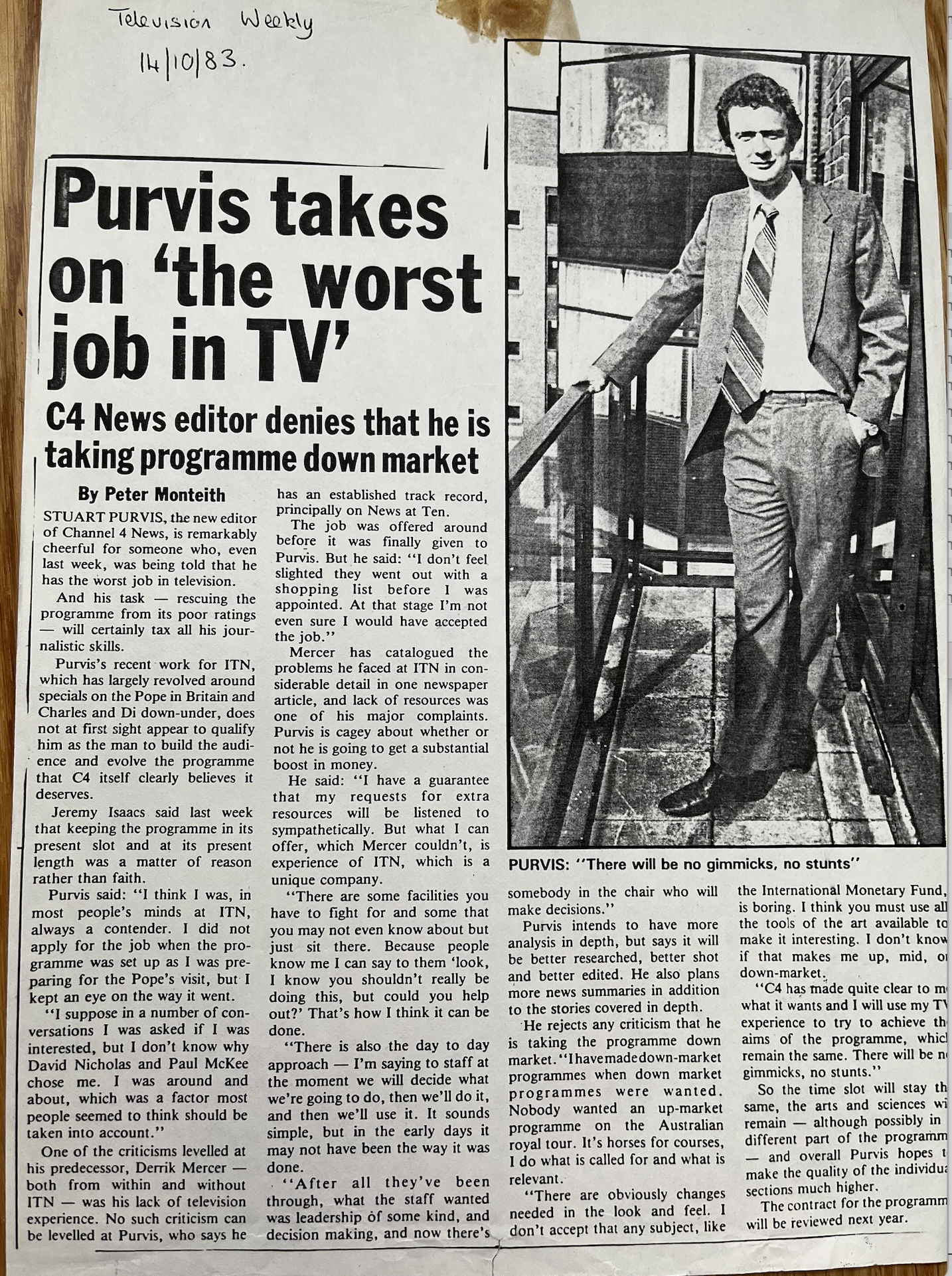
A week after I took over the Editor’s office at Channel Four News in 1983 I found a letter in a desk. It had been left there by Paul McKee who held the fort between the departure of  Derrik Mercer and my arrival, I suspect it was not intended for my eyes. The Chief Executive of Channel Four, Jeremy Isaacs, was informing his ITN counterpart, David Nicholas, that he reluctantly accepted me as Editor but there was a condition: if the ratings did not reach 750,000 within six months the programme would be shut down. 

This was news to me. The C4N audience had gone as low as 250,000 which in TV jargon gave it a ‘TVR’ of zero. So I had moved from Britain’s most popular news programme, News at Ten, to the ‘news with no viewers’. The trade press wondered about my sanity.

What they didn’t know was that I had taken on ‘the worst job in TV’ only to to discover there was a death sentence hanging over it. I decided never to share my secret with my new colleagues for fear it would cause a rush to the exits.

The staff would be the key to saving Channel Four News. Peter Sissons, Trevor McDonald, Elinor Goodman, Lawrence McGinty, Michael Crick, Edward Stourton, Jane Corbin and Ian Ross were among a first rate roll call of on-screen journalists. Overseeing the VTR operation was the redoubtable Sid Stiller and among the graphics team Lesley Everett was a rising star. On the news input desks John Flewin, Garron ‘Garbled Brains’ Baines and Angela Frier were under-appreciated stalwarts. We even had a future Deputy Prime Minister in Damian Green running the business desk.

But feelings about the events of the first year of C4N were still running high. Now the team were suspicious about a new editor who, as Edward Stourton writes in his forthcoming autobiography, had ‘a reputation for populism of a most un-Channel 4-ish kind”.

My own priority was answer the simple question; what was the point of Channel Four News other than it lasted an hour? To Peter Sissons “it was blindingly obvious”. We should choose the news stories of the day which raised issues and deal with them intelligently and if necessary at length. I thought we needed a format which meant the viewer should be able to watch C4N and not need to find any other news that evening. Rather than ignore what I called the ‘video river’ flowing through ITN from its crews and agency suppliers we needed to exploit it.

First Channel Four, who had grudgingly appointed ITN as their news provider in the first place, had to be weaned off an obsession with what they called ‘identifiable analysis’, a code for lengthy studio interviews with experts. My alternative was to thread analysis through the video packages of seven or more minutes using our own in-house expertise plus outside pundits. That would mean a  bigger budget and to their credit C4 agreed.

A week after handing out piechart diagrams of the new format we put it into action on the first anniversary of the channel. Jeremy Isaacs came to the newsroom in Wells Street and climbed onto a desk to speak to staff.  With his head bumping into the ceiling he delivered an upbeat  message rather different from his secret letter to David Nicholas; “Our commitment to ITN is 101 per cent and I am totally committed to both Stewart and to the production of Channel Four News”. Fortunately the team took this as good news rather the dreaded vote of confidence in the manager who is about to be fired. The six month clock began counting down to either ratings success or shutdown. 

There were many difficult moments. Edward Stourton recalls my ‘brutal determination to drag up standards’ in post-mortems after each show. Free drinks in my office afterwards didn’t always smooth over wounded feelings. The night we showed a live shot of empty aircraft steps at Gatwick for far too long brought record ratings but a complaint from Channel Four that this ‘was the wrong kind of journalism’. My explanation was that the British hostages released by Libya had got too drunk on the plane to leave. It cut little ice. 

However overall we were doing more right than wrong, scepticism among the team was giving way to enthusiasm and there was even encouraging external praise from, of all places, the Financial Times and the Los Angeles Times. Then came awards first at the Broadcasting Press Guild, then BAFTA and the Royal Television Society. Our coverage of the Miners Strike was the breakthrough moment when the wider world took notice especially when miners’ leader Arthur Scargill and Coal Board Chairman Ian McGregor made their own films and also debated live on air, the only time they ever spoke to each other in public, and maybe in private too.

One day I got a call from Channel Four to say that such was the progress that the six month deadline was off the table. The programme was safe even if we didn’t reach 750,000. In fact we did make that ratings target anyway.

40 years later the current ratings are not far off 750,000 which is an extraordinary achievement in the context of the enormous decline in linear TV viewing. So Channel Four News now has a greater share of the TV news viewing cake than it did back in those early days. 

The best single decision I made was to build the programme around Peter Sissons. Subsequently Richard Tait’s decision to do the same with Jon Snow ensured extraordinary continuity over nearly four decades. During those years Channel Four teams have upheld and strengthened the reputation for intelligent, challenging and news-making journalism. They continue to win awards around the world.

In Peter’ Sissons own words in his 2011 biography: “Having worked on every major terrestrial TV news broadcast on the BBC,ITV and Channel Four, it is my view that Channel Four News is the one that can make other flagships look pedestrian and predictable”.

This article first appeared in the ITN 55 Club newsletter

SIR DAVID NICHOLAS 1930-2022

This is the obituary I wrote for the monthly newsletter published by former ITN staff.

David Nicholas loved everything about news. He enjoyed finding it which is why during the Cold War he often listened overnight to Moscow Radio in English hoping to hear first about the demise of yet another Soviet leader or a space success. He delighted in sharing it which is why he rang some of us in the middle of night to tell us what he’d just heard. David never lost his life-long enthusiasm for discovery, he read at least five newspapers a day, his final email to me was about a NASA Voyager journey to a distant star last year. 

His curiosity about the wider world may first have been aroused while growing up in Tregaron, a market town in mid-Wales where in the 1930s there were more horses and carts than cars. His school lessons were in Welsh, the first language of his grandparents. A family move south took him to English-speaking Neath Grammar School and onwards to Aberystwyth University where his friends thought he was a ‘bit odd’ for wanting to be a journalist. During his National Service he was promoted to Sergeant Nicholas, he considered the army as a career. That military background would prove useful to him during the Northern Ireland troubles and the Falklands War when he tried to find a balance between the freedom of the media and the needs of military security and public safety. 

The army’s loss of a potential young recruit was to be journalism’s gain. But only just, a job on the Wakefield Express covering rugby league was the only one on offer despite hundreds of his applications. “When I feel depressed, I thank God I don’t still have to write eight columns a week on Wakefield Trinity” he once said. 

Then came the slightly broader horizons of the Yorkshire Post, before the big move to Fleet Street working as a sub-editor on the Daily Telegraph and Observer, then to ITN as a scriptwriter in 1960.

By 1967 when ITN persuaded the IBA and ITV to allow a 13 week trial of a half-hour news programme at ten o’clock, David had earned enough trust from the editor Geoffrey Cox to be put in charge. News at Ten became a national institution. David called it ‘popular photo-journalism’ blending vivid picture power, human angles, exclusives and background analysis. 

Week after week in the late 1960s and early 1970s News at Ten was regularly in the list of the most watched TV programmes alongside Coronation Street with up to fifteen million viewers. Everybody regarded it as the UK’s flagship TV news, even the BBC. Who would have thought back in 1967 that it would still be in the ITV schedule over 50 years later? 

In 1968 when Geoffrey Cox left ITN David was the heir apparent, he was deputy editor and had created a ratings winner, but the ITV companies who owned ITN preferred Nigel Ryan. It was a shock and a setback to David but rather than leave he served nearly a decade under Nigel before finally getting the big job in 1977.

Throughout the David Nicholas decades as Editor, Chief Executive and then Chairman of ITN there were constant themes across the coverage of geo-political and social change, wars and famines, disasters and discoveries plus, of course, countless ‘And Finally’ items.

One theme was innovation. “every week we tried to do something that hadn’t been done before” he once told me. Some of his ideas came from technology, as far back as the 1966 General Election an English Electric KDF 6 computer processed the results and David became determined to turn the data into TV graphics. He succeeded, most famously with a computer first used to design knitting patterns. David was equally determined that ITN should be at the forefront of satellite news gathering, first used all the way from Wembley and then more famously with the Queen on the Great Wall of China in 1986. 

The puling power of live events was another Nicholas hallmark and they didn’t come much bigger than man landing on the moon in the middle of a July night in 1969. ITV, in the shape of Lew Grade, was persuaded by David to invest large amounts of airtime and money and David Frost was drafted in to join the familiar ITN special events team of Alastair Burnet with David Nicholas and Diana Edwards-Jones in the control room. David always wanted these big event programmes to be ‘the best party in town’ and in the run-up to the landing his party was more popular than the BBC’s version.

This was possibly the highpoint in his relations with ITV, in later years arguments about budgets, overspends, the scheduling of special events, even the issue of ITV’s ownership of ITN were to come between the two sides. David and ITV did not part on good terms but his long-term legacy is a universally respected news provider not only to ITV but to the two other commercially funded public service broadcasters, Channels Four and Five. 

One development David never got enough credit for was the televising of Parliament. The experimental ‘Their Lordships House’ on Channel Four combined with relentless lobbying over many years of David’s many political contacts finally produced success. I sat alongside him in the Commons gallery in 1988 when MPs debated the issue for the eleventh time and I remember the Conservative Government front bench looking up and smiling as he finally won the day despite Margaret Thatcher’s wishes.

On a personal level David was ferociously loyal, some might even say too loyal at times. Not so the ITN team of Michael Nicholson, Tom Phillips and Mickey Doyle trapped in Angola for four and a half months in 1978 while filming with a rebel group. David organised a rescue mission and never forgot the bravery of the pilot who landed at the rendezvous in the bush and brought out the ITN team. When the pilot later needed expensive medical treatment David insisted that ITN arranged and paid for it. 

Many ITN staff will remember an inspirational and respected leader who always made sure his people were brought home safely. It is no exaggeration to say that he created an ITN family with high editorial standards and values. David also talked of ‘the ITN diaspora’ and on his death so many people, some now in senior broadcasting roles around the world, said they were proud to be part of it. They sent condolences to David’s son James, himself a former ITN cameraman, and James’s partner Amanda who helped him care for David for so many years near their home in Cheshire. Condolences too to David’s daughter Helen and her family in America.

The oldest amongst us also remember with great affection the love of David’s life, Juliet Davies as she was when they first met as 8 years-old at a birthday party, Lady Juliet Nicholas as she proudly became, the matriarch of both families, the ITN one and the Nicholas one. Both families loved the man we now mourn, the boss who changed so many of our lives and always for the better.

TRIBUTE TO DAVID PHILLIPS

This is the text of the address given by Phil Moger at the funeral of former ITN and NBC producer David Phillips on 24th September 2021 at Guildford Crematorium. Phil worked closely with David on the ITN News at 5.45. A Guardian obituary of David is at https://www.theguardian.com/tv-and-radio/2021/sep/15/david-phillips-obituary.

David Phillips was simply one the finest broadcast journalists I have ever known.

Outside, working with reporters he was in a league of his own; in the office, masterminding the News at 545 he changed the face of tv journalism. I was proud to work with him and eventually take over as editor of that programme.

David was dynamic. And he was charismatic. And it was never less than exciting to work with him.

But there’s someone who has got better words than me..Gerry Seymour the novelist (who is here today). Gerry was an ITN reporter and worked with David on some of the biggest stories of last century.. He says David was irascible, brilliant, innovative, stubborn and inspirational.

It’s good that I mention Gerry because if you wrote a book about David and some of the ways he worked it would be regarded as unlikely fiction.

And if it was turned into a film, the star would have to be Tom Cruise because he is the only actor who could do the stunts that David pulled off.

David worked for ITN for 20 years.  I’ve picked out some highlights to show his raw talent.

For the first, to get the full impact of the importance go home tonight get on the internet and look up Dawson’s Field explosions.

In 1970, Palestinian terrorists hijacked three airliners and flew them to a dessert airstrip in Jordan. There after offloading the hostage passengers they blew up the planes. One of them was a BOAC VC10

A freelance cameraman working for ITN was the only person to get the picture. There were no satellites or mobile phones.  Everything was on film. This was a massive story that the world was hungry to see.

David grabbed the rolls of film and drove to Amman airport. But there were no flights out.  No planes.  Except for one…a Caravel airliner not due to fly..  David found the pilot and with an American tv man they persuaded him to fly out that night  to Nicosia. for a princely sum…£25,000 in today’s money. Two of them in an eighty seater plane.

David dashed off that plane to find all flights to London were full.  But he persuaded another pilot a BEA captain to let him fly in the jump seat .

In Britain three picture editors worked in relays on the film.  And a half hour programme went out that night – a world exclusive thanks mainly to David. 

It’s yet another flight that brought another exclusive for David…with Gerry Seymour.

In 1972 Palestinian terrorists killed the Israeli athletics team at the Munich Olympics. In a shoot out five of the terrorists were killed but three surrendered.

It was another massive story. Suddenly the Germans released the three who flew to Tripoli. In Munich David hired an executive jet and with Gerry flew after them. A worried Foreign desk  in London asked David “And how much is that gonna cost us this time” “Sorry mate, haven’t a clue” said David.

The ITN pair had no visas . No landing clearance  when they took off.

David and Gerry DID land, arranged to interview the terrorists and hid from the worlds press who were also after the interviews.  But Gerry got them, another world exclusive.  Gerry was to say later David never entertained a fear of failure that day.

David wrote two books about hijackings.  One of them I have here Leila’s Hijack War co written with another ITN journo Peter Snow. I HAVE ONE OF THE FEW REMAINING COPIES IN CIRCULATION. That’s because my wife, News at Ten director Jacqui Bromley typed the manuscript of the book and proof read it.

On lighter topics  David loved anecdotes and I am indebted to Stewart Purvis for this one.  David was at the Montreal Olympics on a radio programme where journalists were discussing their coverage.  A German woman – Dagmar – listed all the problems her team had faced.  David listed all ITN’s successes and said “Hard lines Dagmar .”  She replied “ You are a very rude man ”.  And David replied.  “Me rude, me rude, your’e the German”.

David’s biggest success was being the brains behind a new early evening news programme, The News at 545.  It started in 1977. A different broadcasting world.  No Sky, No 24 hour  BBC news, No Channel four or five.

ITN had its News at Ten but early in the evening it was a ten minute bulletin a hotchpotch of what was to come later in the evening.

The new News at 545 – fifteen minutes long – covered stories that had never been covered on television before.  A nod to the popular press –the Mail, the Mirror etc Ed Stourton once said it was regarded at the time as a bit risqué.

. And it liked sport..a horse race every day.  We were told the Queen mum was a viewer because of this

The whole idea was to make it a good evening paper. David had been a sub on the Manchester Evening News and the London Evening Standard. David’s great talent was spotting a story which people would be talking about at home or in the pub and pushing it up the bulletin to story three or four and, if  it were a quite day, even the main story..

David told me he had a picture of his scenario. A husband comes home to his wife or wife comes home to her husband and as they come through the door they say; HAVE YOU HEARD THIS. 

Example: Recently,  The rolling stones drummer Charlie Watts died.  Known to all generations big time.  A programme I saw headlined it but made it an” And finally.”

Now Afghanistan was big this day so it would not have been the lead but David – and myself – that story would have to be second or third. That was the Phillips difference.  And that’s how he changed the face of tv journalism

Other programmes soon started changing what they covered. It’s what we see today…David’s part in history. And ratings soared

Throughout  David retained his love of the unusual.  Concorde fought for years to be allowed to land in New York.  When it did he negotiated with British Airways to do the landing LIVE IN THE NEWS AT 545. We prayed that day for it to be on time. It was. A great cheer went up in he tv gallery.

And David introduced another innovation — end titles covered in film. I was his main picture man on the Concorde day.  And  on that day we had Concorde’s captain waving his hat in the air from Concorde’s window. As a goodnight.

David left ITN to get back to field producing . That saddened many of us.  He went to  the American company NBC . He was Paris Bureau chief and London deputy chief.

But David never did things by halves.  On the day he left ITN he was taking it easy: his last programme had been put together before lunch.  At three that afternoon Irish terrorists blew up he car of Airey Neave, the shadow Northern Ireland Secretary killing him. Two hours before deadline the whole programme had to be redone.

It was one of his finest.

One final point

 I have gone through dozens of documents to write  David’s obits, many supplied brilliantly by his son Guy head of ITV regional news. 

I came across one phrase written by David; “I get my energy through enthusiasm.”

I never spent a day when David wasn’t enthusiastic.  That phrase should be pined up in every newsroom  because without enthusiasm you put out a dull product.

And David knew that better than anybody .Energy through enthusiasm is the legacy he leaves us.