The announcement of a General Election on 4 July makes it an appropriate time to look back at how the connection between politics and regulation may have been a factor in Ofcom’s attitude to GB News at the time of the channel’s launch in June 2021.
The relevant sequence of events began in 2018:
2018 Lord Burns was appointed as Chair of Ofcom for a 4 year term. The appointment was made while Theresa May was Prime Minister.
June 2019 It was announced that the CEO of Ofcom, Sharon White, would be stepping down to become the Chair of the John Lewis Partnership. Lord Burns soon began the search for a replacement for his CEO.
July 2019 Boris Johnson became Prime Minister and focused, among other things, on getting the ‘right people’ into important public appointments.
2020 Lord Burns resigned as Chair after only 2 years and Melanie Dawes was appointed CEO. This was an unusual combination of events, normally Ofcom chairs like to be around to settle in a new CEO. It led to speculation that Melanie Dawes was Terry Burns’s preferred candidate for CEO but that Boris Johnson had insisted that Burns departure was the price of her appointment. The Guardian reported; ‘Burns is believed to have tussled with the prime minister over the appointment of a new Ofcom chief executive. Eventually he agreed to leave in order to get his own choice of Melanie Dawes’. The deputy Chair Maggie Carver became the acting Chair while the Government set about installing Paul Dacre, former Editor of the Daily Mail, as the new Chair..
May 2021 Paul Dacre’s application for the post of Chair appeared to fall at the first fence when a panel considering it rejected him. However Boris Johnson’s Government refused to accept this as the final word and set about re-running the selection process in a different way to ensure Dacre’s appointment.
June 2021 GB News launched and after only one week Ofcom executive Kevin Bakhurst told a Media Society event that he saw nothing wrong with the content. This was another unusual event. Normally Ofcom executives would not give an instant judgement on a new channel especially when it was clear there were going to be complaints which Ofcom would have to consider.
Nov 2021 Paul Dacre pulled out of the contest to become Chair and questioned whether Melanie Dawes was up to the job. The Guardian reported: ‘Dacre said the prime minister had given him the go-ahead to sack the existing Ofcom chief executive, Melanie Dawes, and appoint a fresh figure’ .
The bottom line: at the very moment GB News was launching and Ofcom was considering whether it breached the due impartiality rules the regulator’s CEO was aware that the Government was determined to install Paul Dacre as her new boss.
If these circumstances led Ofcom to make a decision about GB News’s compliance or otherwise with the due impartiality regulations because of the likely views of the man they expected the Government to appoint as their new Chair that would be unprecedented and it would be wrong.
Ofcom have published more than 100 pages of research and new guidance about their rules on ‘due impartiality’ which will probably affect GB News the most. Are we any wiser about the impact on the forthcoming general election campaign?
1. What’s the bottom line?
Last month I wrote an article for the Guardian with a former colleague at Ofcom, Chris Banatvala. We asked three questions, now we have enough information from Ofcom on their current policies to be able to answer our own questions.
Q Is Ofcom going to allow senior party officials to present election programmes as long as they are not actual candidates?
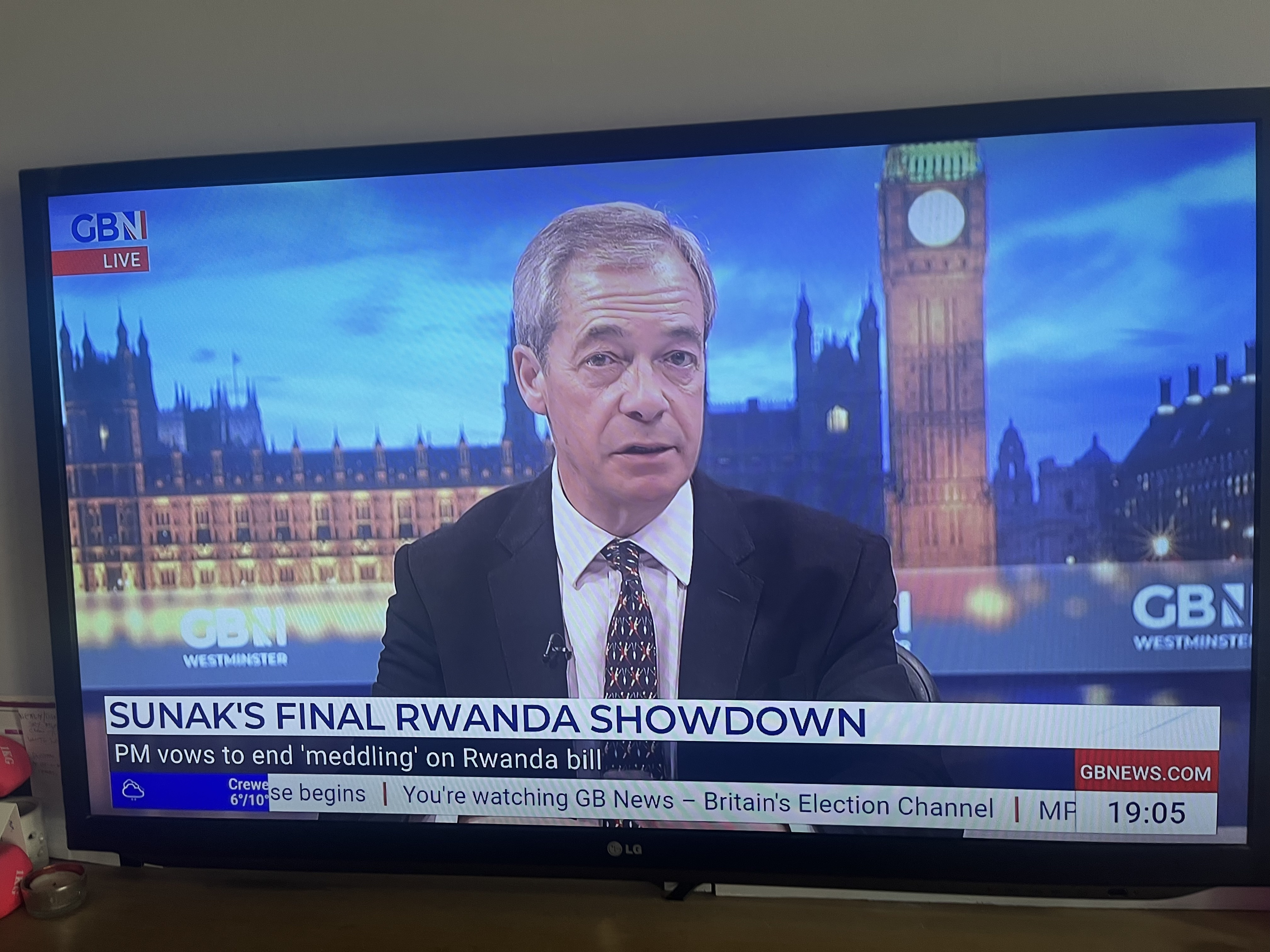
A Yes. Under Ofcom’s current interpretation of their rules the Honorary President of the Reform UK Party, Nigel Farage, who is also a director and co-owner of the party, will be able to present his weeknight prime time programme on GB News unless he stands as a candidate. He will be able to do this throughout the election campaign – even though Reform UK says it will stand around 600 candidates
Q Could a channel host party loyalists from only one side, delivering nightly unchallenged polemics on each day’s campaign news?
A. Yes unless they are candidates. And party officials, assembly members and political activists will all be allowed to interview representatives of their own party every day of the campaign. Ofcom would probably challenge the word ‘unchallenged’ but the truth is that day after day on GB News contentious statements are made and not challenged and there is little regulatory follow-up.
Q. Will channels with poor compliance records and fewer viewers than the public service broadcasters be given greater flexibility in achieving “due impartiality” on the basis of what Ofcom calls “audience expectations”?
A.The suggestion that Ofcom was operating this two-tier system came from none other than the CEO of Ofcom, Dame Melanie Dawes, when she told an event in Oxford ‘the standard for someone like the BBC, which reaches still 70 per cent of the TV viewing audience, [for] the news is a different one from that of a channel that has an audience of maybe four or five per cent of the viewing public. We expect different things. And I think that’s appropriate.”
When challenged before a potential legal action by Professor Julian Petley and the Good Law Practice, Ofcom now say that these were ‘two brief remarks made in the context of a live Q&A interview’ and that the comments ‘were clearly not intended to be, and should not be taken as, an unpublished policy position of Ofcom’. I think that’s Ofcom code for ‘the CEO mis-spoke’.
2. What does the audience research show ?
Ofcom say ‘the report captures a wide range of views but, overall, the audience feedback supports the broad design of existing due impartiality rules under the Broadcasting Code’. Cynics would suggest that’s exactly what the research was designed to do so let’s examine one issue in detail.
Under Ofcom’s current interpretation of the rules politicians cannot present news programmes but they can present ‘current affairs’. As I have pointed out before the distinction between these two genres was not set out in the law that created Ofcom, the regulations Ofcom enforce or the guidance it has provided to broadcasters. It only existed in a blog by an executive. Now Ofcom is taking the opportunity provided by the research to change the guidance to codify the blog. But is that what the audience research really shows?
When the research project was first commissioned the Ofcom Chairman, Lord Grade, took the unusual step of predicting what it would discover, telling a Voice of the Listener and Viewer conference that he was sure the audience would know the difference between news and current affairs.
The evidence from ’29 focus groups with 157 participants from range of backgrounds, reflecting different political leanings and media consumption habits from all across the UK’ tells a different story. This being ‘qualitative’ not ‘quantitative’ the research company Ipsos does not provide numbers of who thinks what but instead attempts to summarise what the groups said.
‘Participants thought they could easily distinguish between news and current affairs content and name common features of both in principle. However, in practice, the presentation and style of these types of content blurred the line between news and current affairs which confused participants particularly when a programme contained both’.
Dig deeper and you find the audience was even more confused. Four of the key characteristics they associated with news programmes but not current affairs : ’studio backdrop / presenter siting behind a desk / rolling banner /ticker’ are all prominent parts of Nigel Farage’s programme which he is only allowed to present because Ofcom deems it ‘current affairs’.
A further irony is that two of the characteristics they associate with news, rolling banners and tickers, don’t actually appear in news programmes such as the BBC’s Six O’Clock News and ITV’s News at Ten.
This was an especially disappointing result for Ofcom when you consider that the ‘stimulus materials’, the video clips shown to the focus groups, did not include any ‘hybrid’ programmes such as BBC Radio Four ‘Today’, Channel Four News, BBC Newsnight and rolling news sections of Sky News which all have elements of both genres. Such clips would have left the focus groups even more confused since most of the people who make them are not sure themselves if they are news or current affairs or both. Ofcom itself also seems confused. Under its definition these hybrid programmes are probably both news and current affairs. But it always seems to investigate them as news.
So if the evidence is that viewers think they know the difference but actually don’t, what do they think of the principle of politicians presenting ‘current affairs’ programmes?
Ipsos is absolutely clear;
‘The most prevalent opinion held among participants was feeling uncomfortable with politicians presenting current affairs content’.
The raw material includes quotes such as
‘I just don’t think politicians should be doing all these current affairs programmes, or not as many. Female, South England, 55+’.
‘It undermines the topic they’re presenting or discussing. To be on the safe side, stick with presenters who aren’t associated with politics in any way.” Female, Midlands, 35-54.’
But do the viewers think the rules should allow politicians to present these programmes?
Ipsos says ‘not everyone in this group thought they should be prevented from doing so’.
Should we be surprised by that when we read that 11 of the 29 groups ‘were conducted with audiences of channels where politicians have been presenting current affairs programmes more regularly’. You might well expect that ‘not everyone’ in these groups would like to stop the programmes they watch. The real question is was there an overall majority of people who thought that politicians shouldn’t present current affairs programmes. Ipsos would know this but we aren’t told.
Instead Ipsos concludes:
‘Across groups there was common concern about politicians presenting current affairs content, but this did not equate to a consensus on preventing them from presenting such content’.
Ofcom go one step further in their press release :
‘People expressed a range of views about politicians presenting current affairs programmes, but although there were concerns, there’s no clear consensus for an outright ban’.
So ‘a prevalent view’ among viewers that they are ‘feeling uncomfortable’ has been diluted to ‘a range of views’
The final twist comes when an Ofcom executive, Cristina Nicolotti Squires, a former ITN colleague, appears on Radio 4’s Media Show and announces :
‘When it came to current affairs they didn’t particularly like politicians presenting it but they didn’t want it banned’.
Now ‘not everybody’ agreed to a ban has been strengthened to ‘they didn’t want it banned’.
Some evidence base.
3.What subjects weren’t the focus groups asked about?
I can’t find any mention of any groups being asked what they thought of the fact that the politicians who present on GB News all come from the same side of the political divide.
Nor, it seems, were they asked what they would consider to be a reasonable proportion of a programme that should be given to views which are an alternative to those of the politicians who gave the opening monologue.
Perhaps Ofcom didn’t want to know the answer.
My colleague, Chris Banatvala adds this important final point : ‘when all is said and done, this qualitative research shows ‘Across groups there was common concern about politicians presenting current affairs content‘. Surely that is the beginning of the debate and not, as Ofcom seems to imply, the end’.

 ProfPurvis