Last month (September 2025) the Secretary of State for Culture,Media and Sport, Lisa Nandy, launched an attack on “political polemic presented as news” and cited Nigel Farage’s programme on GB News. She told MPs on the Culture Select Committee :
“Ofcom is currently consulting on tightening the rules around politicians presenting news programmes and news in any format and that is something that we as a government strongly support. We will look closely at what Ofcom present to us but it is an area in which we intend to act”.
Just in case Ofcom wasn’t listening, she said something similar at the Royal Television Society conference and again in an interview with the Media Confidential podcast. And in a further flourish before Ofcom announced its decision she followed up on research from Cardiff University, funded by AHRC and carrIed out by YouGov.This found ‘public opposition to allowing politicians to front current affairs programmes – contradicting research carried out by the regulator, Ofcom’. Responding to this finding the Secretary of State doubled down saying the public were “right to be concerned about elected politicians playing the role of news presenters”.
Now we have Ofcom’s decision about politician presenters in a document which also sets out its views on the responses to its consultation. Among those responses was one which I submitted with former Ofcom colleague Chris Banatvala.
There has been much confusion about what the Ofcom announcement means. First the easy bit: the original proposal which Ofcom put out to consultation has been dropped because a range of objectors (including us and GB News) argued it was unworkable. Now the complicated alternative. Ofcom has come up with its Plan B which some readers think is tightening the rules as Lisa Nandy wants and some think loosens them which she certainly doesn’t.
Chris Banatvala has done his own independent forensic examination of the announcement. He explains that Ofcom has decided not to make any changes to the Broadcasting Code which would tighten the rules but instead has refined its ‘non-binding guidance’ in a way which allows the Farage show to continue. He concludes “For the first time ever, Ofcom seems to be allowing politicians to present ‘news, in whatever form’ within non-news programmes but will then consider a number of factors before deciding whether the content is impartial” .
I read that as a loosening of the rules and you don’t have to take my word for it, the positive response from GB News to the announcement confirms this. But maybe the regulator won’t mind a bit of confusion all round, a bit of ‘creative ambiguity’ to leave some potential jeopardy for GB News if it goes too far for the regulator.
We await Ms Nandy’s judgement on whether Ofcom’s ‘Plan B’ has passed her test, has Ofcom tightened ‘the rules around politicians presenting news programmes and news in any format’? .
One other point worth making; the Ofcom announcement does not push back hard against criticism from us and some academics about the quality of that audience research which it has relied upon to justify its position. Instead it promises to ‘explore conducting further research into audience attitudes towards news and current affairs on TV and radio’.
So the next steps to watch out for:
Any response of any kind from Lisa Nandy as to whether Ofcom has met her test.
If it hasn’t, any sign of a way in which the regulator and the minister could find common ground, maybe fresh public attitude research.
Failing that, any sign that the Government does or doesn’t have the taste or the time for legislation?
Meanwhile any new complaints about GB News output which become test cases of Ofcom’s ‘Plan B’.
Some recommendations: Giles Winn’s newsletter ‘ScreenPower’ on Substack is a way of staying in touch with issues ‘where TV and Film meet politics and power’.Roger Bolton’s Beeb Watch podcast has an interview with Professor Stephen Cushion of Cardiff University about his research on the audience’s views on impartiality.
During the four year long debate about whether GB News are breaking the rules requiring impartial broadcast news there has been a noticeably missing voice, a clear view from the Labour Party . That situation ended at 10.45 am on Wednesday 10th September 2025 when the Secretary of State for Culture, Media and Sport, Lisa Nandy, was appearing before the CMS Select Committee. No transcript has yet been released so I have prepared one plus what I think are some key points. (If you want to see the video of the hearing it is here and the relevant section is at 10:45:00).
Lisa Nandy was answering a question about the BBC, talking about its funding and its independence, when she began what looked like a deliberate pivot:
“And If I may on that issue of independence the other thing that the BBC finds very challenging and you know the committee will know that there have been several challenging issues and areas where the BBC has fallen short in recent months is that they are rightly held to the highest of standards but there has been a fracturing of the news media and there are different standards being observed in other places.
“So to take a very clear example of something that this government and I feel very strongly about, there is a real importance for the public when they look at the news to be able to understand whether what they are seeing is political polemic or news. At the moment that situation is currently completely unsatisfactory and there has been a blurring of political polemic that is presented as news on other channels. I am really keen that as part of supporting not just the BBC but all of our public service broadcasters that we make sure that we get those rules right . Ofcom is currently consulting on tightening the rules around politicians presenting news programmes and news in any format and that is something that we as a government strongly support. We will look closely at what Ofcom present to us but it is any area in which we intend to act”.
Labour MP Paul Waugh then asked:
“By implication are you talking about GB News there, I mean obviously like me you’d be a strong supporter of freedom of speech and of the freedom of media and the press but at the same time if you switch on GB News at night it is basically a newspaper on TV format which is not meant to be the Ofcom rules is it?”
The Culture Secretary replied:
“I’ve had particular concerns raised with me by parliamentarians about the appearance of Nigel Farage presenting news programmes on GB News. I think that is a fair criticism from members of parliament of all political parties because the public have a right to know if what they are seeing is news and is impartial or is not and one of the challenges that then creates for public service broadcasters is that people lose trust in the news altogether. Now that is then a challenge for the whole country because the way in which people consume their news has polarised and fragmented and people are reading different accounts. Those shared spaces and that shared understanding is the basis of democracy is fracturing. I think that is very, very dangerous, a very dangerous position for a country to be in and it is something that we intend to robustly defend is the impartiality of our news. It is not for the government ever to stray into determining who can be featured on broadcast media and what is discussed, That is entirely a question for broadcasters whether its GB News, the BBC or others not least because they exist to hold the mirror up to government and subject us to scrutiny and that is essential in any democracy. But it is right and proper that as a government we ensure we have a proper framework so that viewers are empowered to understand if what they are seeing is news or is what they are seeing is political polemic presented as news”.
Some key points:
It may not have had the usual trappings of a major policy change, no pre-briefing, no press statement, but this was a Cabinet minister saying for the first time what, according to her, MPs of all parties have been telling her. Presumably that’s MPs of every party except Reform.
Why now? My hunch is that Labour have always thought this but decided they didn’t need to get involved publicly in what they saw as GB News helping Reform take voters away from the Conservatives. Maybe they’ve decided they are now losing out too and “intend to act”.
How would they act? Ms Nandy said “We will look closely at what Ofcom present to us” on “tightening the rules”. There are two problems with that.
Problem One: Ofcom doesn’t ‘present’ to Government on issues like this, that’s not how an independent regulator is meant to work. When Ofcom announce the outcome of their consultation on the rules (see previous posts) the Government will have to decide whether the problem has been solved or whether some other intervention is necessary, such as a tightening of the legislation.
Problem Two: as argued in previous posts Ofcom’s current plan will not ‘tighten’ the rules because it does not address the core problem, the regulator’s current view that Nigel Farage does not present ‘news’ but ‘current affairs’. That’s why GB News says: “The Culture Secretary is clearly either mistaken or misinformed about the nature of GB News programming.GB News has never and does not use politicians to present news programmes. Politicians can present current affairs programmes.”
Any clues on how the problem could be solved ? Interesting that the SoS mentioned ‘news in any format’. This underlines the point that the Broadcasting Code requires due impartiality in ‘news in whatever form’ not just news bulletins. A revised piece of guidance to the code could build on this and be more precise about what is ‘news in whatever form’ overturning Ofcom’s current view that News Presenter of the Year Nigel Farage doesn’t present news.
Does Lisa Nandy’s involvement help or hinder the argument for the proper enforcement of the rules? The conventional wisdom is that she overplayed her hand on the BBC’s Glastonbury mistakes but learned that lesson. The qualifications set out in the second half of the full transcript of her remarks on impartiality seem to support this.
Next step? Ofcom executives now have to make up their mind after the consultation knowing that whatever they decide the Government have a view and that all the other political parties (and that includes Reform) feel they have a stake in the outcome too.
GB News has announced that Nigel Farage, leader of the Reform Party, who took a break from presenting ‘Farage’ during his successful local election campaign, will return to the channel in ‘early June’.This will create an unprecedented situation in British broadcasting. The leader of a political party who, according to recent polls, has a real chance of becoming the next Prime Minister will have his own programme about the day’s news three times a week from June until the next General Election campaign without any other party leader having to be offered any equivalent airtime.
If that isn’t unusual enough, Farage is returning to the TV presenter’s chair at the very moment the Ofcom regulations about his programme are in a state of limbo. Readers of my last blog will know that in March Ofcom lost an important court case, the first time this has happened on a matter of content regulation. Mrs Justice Collins Rice agreed with a challenge by GB News that Ofcom’s rulings that two GB News broadcasts in 2023 breached the code on ‘due impartiality and due accuracy in news’ were unlawful. Ofcom therefore decided to drop 11 investigations or rulings about broadcasts in which politicians read out news items. Most were on GB News, there were also some cases involving TalkTV and LBC. Ofcom has now published a consultation document on how it wants to change the regulations to solve the problems the court case identified.
In my March blog I forecast that Ofcom would be tempted to confine the consultation to a narrow legal issue rather than take the opportunity to review how it got into this mess in the first place.The cause of the core problem is Ofcom’s decision, going back to when GB News started using politicians as presenters, that this was allowed because these weren’t ‘news’ programmes but ‘current affairs’.
As predicted Ofcom wants to change just a few words but they will create a whole new row. Under the current Rule 5.3 politicians can’t be the ‘newsreader, interviewer or reporter’ in what Ofcom deems to be a news programme. But they can do interviews about the news of the day in what Ofcom regards as ‘current affairs programmes’.
Now the regulator proposes that there should be one rule about politicians which should apply to ‘any type of programme’ and that includes ‘current affairs’ shows. And what should that one rule be? Ofcom obviously has to define what exactly politicians can’t do in ‘any type of programme’. It has chosen : ‘No politician may be used as a newsreader, news interviewer or news reporter in any type of programme’. Let’s focus on that term ‘news interviewer’ which Ofcom has created but not defined. What exactly is a ‘news interview’ or, for that matter, ‘news’ in Ofcom’s mind ? Is a ‘news interview’ an interview in a news bulletin, an interview with a news-maker in a ‘non-news’ programme such as ‘Farage’, any interview about the news of the day or any interview that makes news.
It seems politicians won’t be allowed to do ‘news interviews’ whatever they are but could they do interviews about the news? When does one become the other? Could Nigel Farage interview GB News’s Political Editor, Christopher Hope, live about a story of the day, would that be a ‘news interview’? What would happen if Hope wanted to give viewers an important breaking news update, could he do that? Could Farage ask him a follow up question?
Ofcom has dug itself into another regulatory hole. You do wonder who at Ofcom could have signed this off without realising the implications.
Ofcom have published more than 100 pages of research and new guidance about their rules on ‘due impartiality’ which will probably affect GB News the most. Are we any wiser about the impact on the forthcoming general election campaign?
1. What’s the bottom line?
Last month I wrote an article for the Guardian with a former colleague at Ofcom, Chris Banatvala. We asked three questions, now we have enough information from Ofcom on their current policies to be able to answer our own questions.
Q Is Ofcom going to allow senior party officials to present election programmes as long as they are not actual candidates?
A Yes. Under Ofcom’s current interpretation of their rules the Honorary President of the Reform UK Party, Nigel Farage, who is also a director and co-owner of the party, will be able to present his weeknight prime time programme on GB News unless he stands as a candidate. He will be able to do this throughout the election campaign – even though Reform UK says it will stand around 600 candidates
Q Could a channel host party loyalists from only one side, delivering nightly unchallenged polemics on each day’s campaign news?
A. Yes unless they are candidates. And party officials, assembly members and political activists will all be allowed to interview representatives of their own party every day of the campaign. Ofcom would probably challenge the word ‘unchallenged’ but the truth is that day after day on GB News contentious statements are made and not challenged and there is little regulatory follow-up.
Q. Will channels with poor compliance records and fewer viewers than the public service broadcasters be given greater flexibility in achieving “due impartiality” on the basis of what Ofcom calls “audience expectations”?
A.The suggestion that Ofcom was operating this two-tier system came from none other than the CEO of Ofcom, Dame Melanie Dawes, when she told an event in Oxford ‘the standard for someone like the BBC, which reaches still 70 per cent of the TV viewing audience, [for] the news is a different one from that of a channel that has an audience of maybe four or five per cent of the viewing public. We expect different things. And I think that’s appropriate.”
When challenged before a potential legal action by Professor Julian Petley and the Good Law Practice, Ofcom now say that these were ‘two brief remarks made in the context of a live Q&A interview’ and that the comments ‘were clearly not intended to be, and should not be taken as, an unpublished policy position of Ofcom’. I think that’s Ofcom code for ‘the CEO mis-spoke’.
2. What does the audience research show ?
Ofcom say ‘the report captures a wide range of views but, overall, the audience feedback supports the broad design of existing due impartiality rules under the Broadcasting Code’. Cynics would suggest that’s exactly what the research was designed to do so let’s examine one issue in detail.
Under Ofcom’s current interpretation of the rules politicians cannot present news programmes but they can present ‘current affairs’. As I have pointed out before the distinction between these two genres was not set out in the law that created Ofcom, the regulations Ofcom enforce or the guidance it has provided to broadcasters. It only existed in a blog by an executive. Now Ofcom is taking the opportunity provided by the research to change the guidance to codify the blog. But is that what the audience research really shows?
When the research project was first commissioned the Ofcom Chairman, Lord Grade, took the unusual step of predicting what it would discover, telling a Voice of the Listener and Viewer conference that he was sure the audience would know the difference between news and current affairs.
The evidence from ’29 focus groups with 157 participants from range of backgrounds, reflecting different political leanings and media consumption habits from all across the UK’ tells a different story. This being ‘qualitative’ not ‘quantitative’ the research company Ipsos does not provide numbers of who thinks what but instead attempts to summarise what the groups said.
‘Participants thought they could easily distinguish between news and current affairs content and name common features of both in principle. However, in practice, the presentation and style of these types of content blurred the line between news and current affairs which confused participants particularly when a programme contained both’.
Dig deeper and you find the audience was even more confused. Four of the key characteristics they associated with news programmes but not current affairs : ’studio backdrop / presenter siting behind a desk / rolling banner /ticker’ are all prominent parts of Nigel Farage’s programme which he is only allowed to present because Ofcom deems it ‘current affairs’.
A further irony is that two of the characteristics they associate with news, rolling banners and tickers, don’t actually appear in news programmes such as the BBC’s Six O’Clock News and ITV’s News at Ten.
This was an especially disappointing result for Ofcom when you consider that the ‘stimulus materials’, the video clips shown to the focus groups, did not include any ‘hybrid’ programmes such as BBC Radio Four ‘Today’, Channel Four News, BBC Newsnight and rolling news sections of Sky News which all have elements of both genres. Such clips would have left the focus groups even more confused since most of the people who make them are not sure themselves if they are news or current affairs or both. Ofcom itself also seems confused. Under its definition these hybrid programmes are probably both news and current affairs. But it always seems to investigate them as news.
So if the evidence is that viewers think they know the difference but actually don’t, what do they think of the principle of politicians presenting ‘current affairs’ programmes?
Ipsos is absolutely clear;
‘The most prevalent opinion held among participants was feeling uncomfortable with politicians presenting current affairs content’.
The raw material includes quotes such as
‘I just don’t think politicians should be doing all these current affairs programmes, or not as many. Female, South England, 55+’.
‘It undermines the topic they’re presenting or discussing. To be on the safe side, stick with presenters who aren’t associated with politics in any way.” Female, Midlands, 35-54.’
But do the viewers think the rules should allow politicians to present these programmes?
Ipsos says ‘not everyone in this group thought they should be prevented from doing so’.
Should we be surprised by that when we read that 11 of the 29 groups ‘were conducted with audiences of channels where politicians have been presenting current affairs programmes more regularly’. You might well expect that ‘not everyone’ in these groups would like to stop the programmes they watch. The real question is was there an overall majority of people who thought that politicians shouldn’t present current affairs programmes. Ipsos would know this but we aren’t told.
Instead Ipsos concludes:
‘Across groups there was common concern about politicians presenting current affairs content, but this did not equate to a consensus on preventing them from presenting such content’.
Ofcom go one step further in their press release :
‘People expressed a range of views about politicians presenting current affairs programmes, but although there were concerns, there’s no clear consensus for an outright ban’.
So ‘a prevalent view’ among viewers that they are ‘feeling uncomfortable’ has been diluted to ‘a range of views’
The final twist comes when an Ofcom executive, Cristina Nicolotti Squires, a former ITN colleague, appears on Radio 4’s Media Show and announces :
‘When it came to current affairs they didn’t particularly like politicians presenting it but they didn’t want it banned’.
Now ‘not everybody’ agreed to a ban has been strengthened to ‘they didn’t want it banned’.
Some evidence base.
3.What subjects weren’t the focus groups asked about?
I can’t find any mention of any groups being asked what they thought of the fact that the politicians who present on GB News all come from the same side of the political divide.
Nor, it seems, were they asked what they would consider to be a reasonable proportion of a programme that should be given to views which are an alternative to those of the politicians who gave the opening monologue.
Perhaps Ofcom didn’t want to know the answer.
My colleague, Chris Banatvala adds this important final point : ‘when all is said and done, this qualitative research shows ‘Across groups there was common concern about politicians presenting current affairs content‘. Surely that is the beginning of the debate and not, as Ofcom seems to imply, the end’.
Nigel Farage, not normally a man for self-doubt, has admitted it ‘could be tricky’ choosing between party politics and broadcasting during a General Election campaign. Interviewed for Politico’s ‘Westminster Insider’ podcast ‘Inside GB News’ about his future as the Honorary President of the Reform UK Party he replied:
‘if I want to cover a General Election for GB News under a period of purdah, it could be tricky couldn’t it, could be very difficult and I think ..but I don’t know, I’m thinking very hard about it. But I think it is an either/or choice’
So if Farage stood down from Reform UK and focused on covering the General Election for GB News would he run into trouble with Ofcom rules on GB News which now calls itself ‘Britain’s Election Channel?
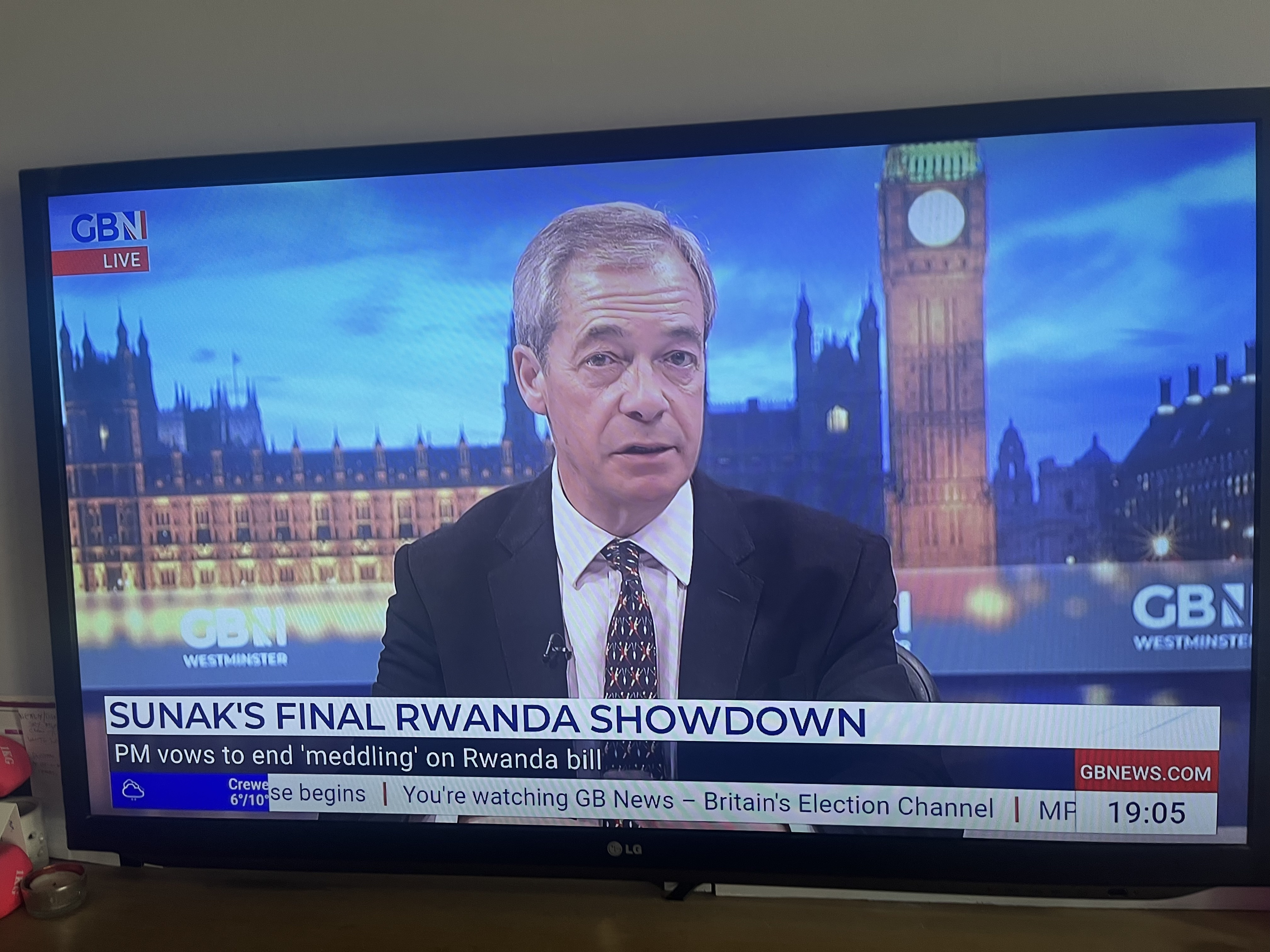
To look ahead at what might be possible I first monitored his current output for a fortnight . Farage regularly echoed Reform UK’s attacks on Rishi Sunak’s ‘Brexit failures’ asking viewers ‘why do we believe a word they say’. For the past two nights Farage has quoted from what he calls his ‘Rwanda Files’, apparently leaked documents from the Home Office. He says that Sunak ‘wilfully deceived the nation’ over ‘Stop the Boats’ when he said in March last year that under the Illegal Immigration Bill immigrants on boats would be removed from the UK ‘within weeks’. Farage says the Home Office knew that couldn’t happen. After his first attack there was no coverage on his programme of any response from the Prime Minister or the Home Office, the second night saw a one paragraph quote from the Home Office.
The most common ‘Farage’ format is best described as the “I agree with Nigel’ nights:
Opening monologue; a familiar narrative of illegal immigrants and the crimes some have committed, the shortcomings of the Government’s Rwanda Bill and Britain’s ‘exploding population’.
An interview with a GB News correspondent who plays a relatively straight bat on an issue of the day.
Interviews with experts: these are not the ‘fruitcakes and loonies and closet racists’ who David Cameron once said comprised Farage’s UKIP party. They are Daily Telegraph correspondents, former army officers and chaplains to Queen Elizabeth. What they have in common is that they agree with Nigel. Sometimes they tell him that and sometimes he tells them.
Captions summarising the reaction of viewers so far, normally three people who agree with Nigel.
A second monologue, titled ‘WTF’, in which Farage attacks his usual suspects such as the EU, Prince Harry and ‘senile’ Joe Biden.
The irony about this format is that the rare occasions when a guest completely disagrees with Farage produces the best television. Labour supporter Scarlett MccGwire refuted his claim that the anger of Muslim voters over Gaza could be the start of ‘sectarian politics’ in Britain and damage Labour. She replied that ‘you are much more dangerous’ for the Conservatives because ‘you are going to make sure they lose the election’.
During my monitoring there were fewer interviews with MPs than I expected. Over the period I counted six Conservative MPs being interviewed by Farage, all were Brexiteers, but there were no Labour or Liberal Democrat MPs.
That kind of imbalance wouldn’t previously have been countenanced by broadcasters or allowed by regulators but the current Ofcom regime have emphasised the freedom which they are currently giving to broadcasters to provide impartiality in their own way.
In the podcast interview Farage emphasised the editorial freedom which he’s been given by GB News. So what could a Farage election campaign programme look like ?
1. Ofcom say that during election campaigns ‘It is not acceptable for presenters to use their position to encourage and urge voters to support political parties or candidates’. Farage is smart enough to avoid the call to action which got Talk Sport presenter James Whale into trouble with Ofcom during the Mayor of London election in 2008:
‘if people did not vote for Boris Johnson then they had only themselves to blame if “Livingstone gets in for another term”.
2. Ofcom also say ‘Due weight must be given to the coverage of parties and independent candidates during the election period’. GB News could solve this by extending the news bulletin that precedes Farage’s show to include more campaign coverage clips.
3.Since Ofcom seem to have no problem with the ‘I agree with Nigel format’ expect more ‘experts’ who tell Nigel, as one did during my monitoring period, ‘you’re quite right’.
4. The biggest change to the Farage status quo would have to be the selection of guests from political parties: 6-0 to the Tories won’t wash in an election. And Reform will certainly expect a say.
So there’s a possible template, now Farage has to make his ‘either Reform or GB News’ decision: either campaign for Reform and lose friends in the Tory Party by costing them votes or stay on air on GB News building an even bigger profile and preparing for a future Tory leadership election.

 ProfPurvis